Written by Alex South
How to cite this page: South, Alex. “Pilot Whales,” Listening With Whales, 29 September 2026, https://listeningwithwhales.org/pilot-whales.
To listen to a field recording of a pod of pilot whales socializing is to enter an acoustic world of intense looping whistles, slow rising creaks, and penetrating high shrieks that demand your attention and lacerate your eardrums. Repeated plaintive distant calls overlap with exultant hoots, brassy rasps, and protracted constricted noises like Donald Duck vocalizing on helium. All of this is accompanied by the electrostatic fizz and crackle of echolocation click series which sometimes accelerate into buzzes or agglomerate into heavy thuds.
We know that pilot whales, along with their other toothed whale kin, rely on the active production of narrow-beam echolocation clicks to sense their surroundings, but we cannot simply map cetacean hearing onto human seeing and have done with it. Pilot whales are much more sensitive to high frequency sounds than we are (Pacini et al. 2010), and their brains are differently wired to ours: recent work on the neural basis for cetacean echolocation has suggested that “touching” may be a better metaphor than “seeing” with sound (Cottier 2025).
The long-finned pilot whale sounds of the video included in this page were recorded in the Vestfjord (Norway) by Heike Vester (oceansounds). They are included on the album Marine Mammals and Fish of Lofoten and Vesterålen.
When it comes to the function of pilot whale creaks and shrieks, there are further complications. Echolocation click sounds, although certainly employed in navigation and foraging, are also used in toothed whale communication, albeit in modified form (Tyack 2019). Meanwhile, although early research into long-finned pilot whales uncovered associations between broad types of sounds and broad kinds of behaviour, pointing to their use to maintain contact and co-ordinate collective movement (Weilgart and Whitehead 1990), the precise communicative functions of whistles and calls remain unknown. In part, this may be because scientists have struggled to reach agreement on the number or nomenclature of sound types, beyond their distinction into ‘clicks’, ‘whistles’, and ‘pulsed calls’.
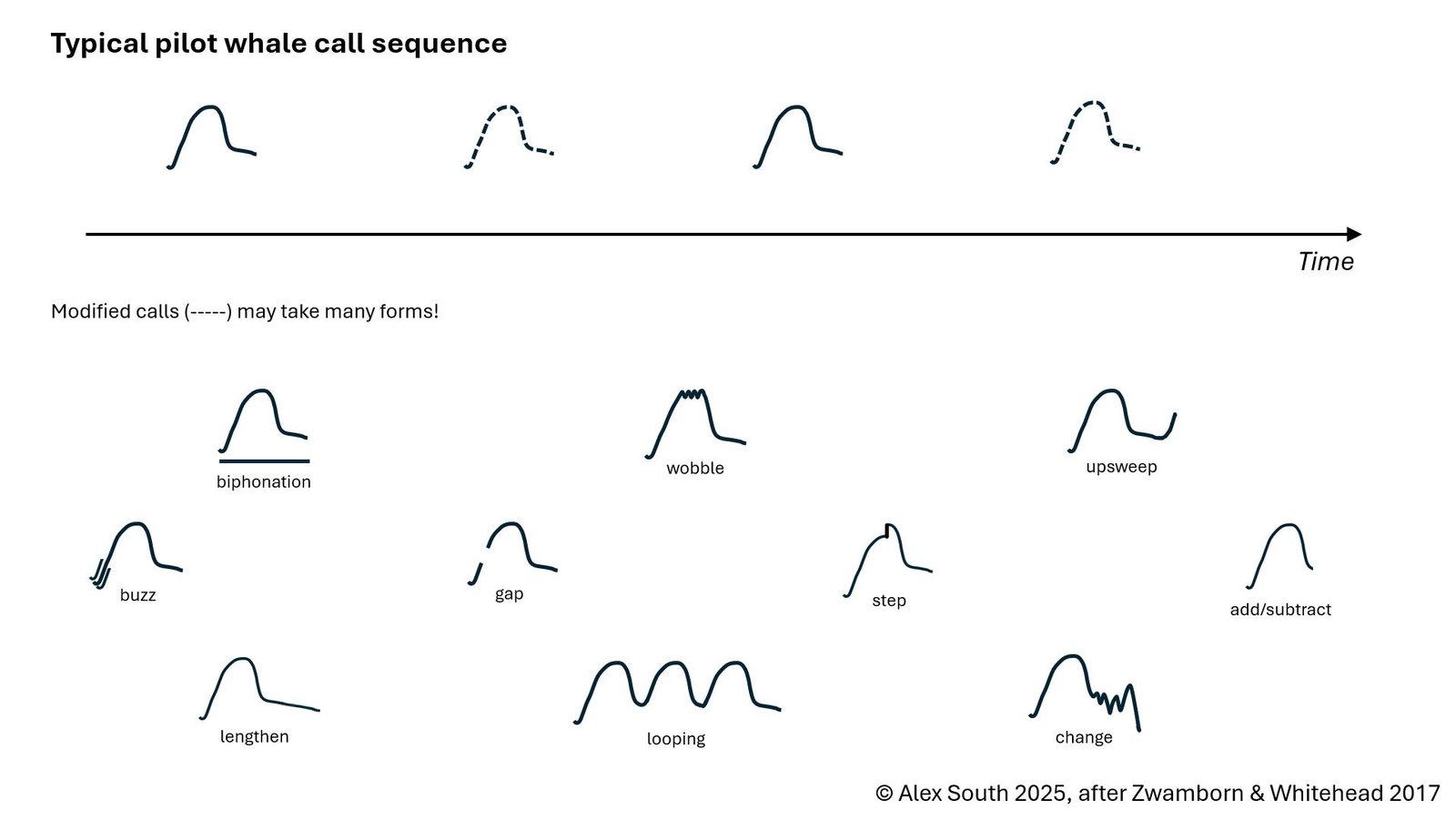
Recent studies of the vocal repertoires in the closely related short- and long-finned pilot whales have identified anywhere between a handful of and nearly 200 distinct call types (Sayigh et al. 2013; Vester et al. 2017; Courts et al. 2020; Benti et al. 2025), with one study of long-finned pilot whale vocalizations also describing ten forms of ornamentation including biphonation, upsweeps, and wobbles (Zwamborn and Whitehead 2017). Another discovered ultrasonic whistles, inaudible to the human ear (Vester et al. 2017). In bioacoustics, such differences in ‘lumpy’ or ‘splitty’ categorization schemes can arise out of different research questions, but here there seems to be a further difficulty: many pilot whale vocalizations seem to be inherently ‘graded’ rather than ‘discrete’. This is to say that these sounds – at least in our human experience and/or representations of them – vary along a continuum rather than falling into obvious classes.
I have just described some of the uncertainties arising from scientific listenings to pilot whales engaged in their day-to-day activities, but of course there are many other modes of listening, some associated with very particular circumstances. For pilot whales, this includes the mass live strandings to which these highly social animals are particularly prone. During these events, mothers and calves sometimes continue to vocalize to each other, using high whistles (Boys et al. 2022). These vocalizations, although heartbreaking for human respondents present, may offer clues to the welfare of individual whales.
Additionally, the existence of such exchanges clearly points to the function of establishing or maintaining social contact through sound, a function that we humans quite obviously share. Such cross-species capacities can also become potential channels of cross-species care, as when human rescuers intuitively begin to talk or sing to stranded whales (South 2026).
However, ambiguity can remain, as reported by a rescuer who spent several hours looking after a stranded pilot whale in the Outer Hebrides (Scotland). Describing the singing of a Gaelic lullaby, she wondered about its efficacy for the whale in her care: “maybe it was me that was being soothed or comforted, I’m not sure” (Gregory 2023). For me, listening to pilot whales in the absence of their presence, I have a vivid sense of meaningful yet incomprehensible utterances, exchanges, co-ordinated and perhaps even concerted vocalizing. Aware of the differences – bodily, perceptual, cognitive, social – wrought by c.50 million years of separate evolution in very different environments, I am content to live with that sense of mystery.
Researching Pilot Whales
Short- and long-finned pilot whales communicate and express themselves through a large variety of clicks, whistles, burst pulses and other vocalizations. Their vocal and other behaviours, ecology, and population dynamics are studied by the Cape Breton Pilot Whale Project (Canada), Cascadia Research Collective (Hawai’i), and Ocean Sounds (Norway), where you will find more audio and video recordings.
Such cross-species capacities can also become potential channels of cross-species care, as when human rescuers intuitively begin to talk or sing to stranded whales (South, 2026). Humans have also drawn on scientific research into pilot whale vocal abilities to create musical scores.
Grieving and Keening with Pilot Whales
Wanna add to the cultural history of pilot whales? Join the current!
Did you catch a mistake? Report it for a krill!
Listening with Whales is a living, growing digital commons. Whistle it out!