Written by Finley Woodson-Gammon
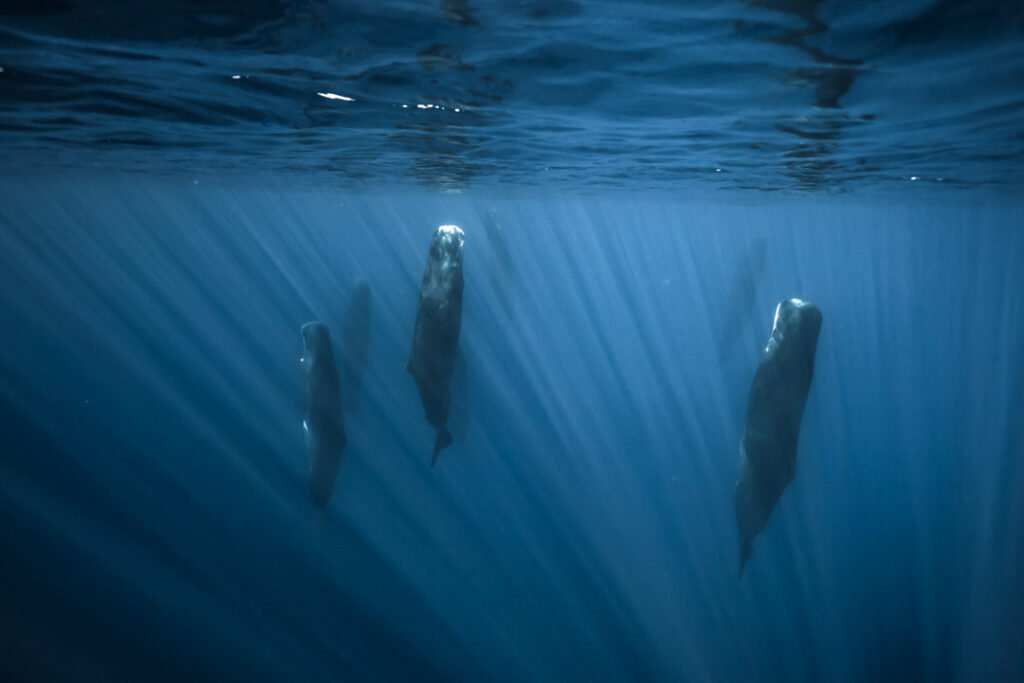
How to cite this page: Woodson-Gammon, Finley. “Cachalots,” Listening With Whales, 7 October 2026, https://listeningwithwhales.org/cachalots. Photo credit: A pod of cachalots. Gabriel Barathieu, CC BY-SA 2.0, via Wikimedia Commons
Sometimes, during calm moments, a family group of cachalots can be seen resting vertically, their enormous, wrinkled heads turned toward the surface. Their long, gray bodies hang three to fifteen meters below, drifting along together, holding their buoyancy through the oil in their noses and perhaps fine-tuning it with the release of tiny bubbles of gas. Together, they will rest for several minutes before waking in unison to breathe and then resume the day’s activities. These rare glimpses into cachalot family life hint at the immense weight the bonds of these whales carry.
Their families are matrilineal and matriarchal. Generations of females and their female offspring live together for life, and the labor of guarding the young is shared among all the adults. For instance, clan members will rotate between diving to hunt and remaining near the surface with calves too young to follow. In line with matriarchal societies in several other species, cachalots do not organize themselves around aggression-based top-down leadership. Instead, decisions about where to move and what to do seem to emerge through intimate, collective consensus.
Families, in turn, belong to larger clans, and clans can be distinguished by the rhythms of their voices. Cachalots speak to one another through codas: patterned sequences of loud and soft clicks, different from the clicks they use to echolocate, that are used to speak one another. Each clan has its own coda dialect. Clans frequently share the same waters, but they tend not to mix, and they keep their dialects distinct. This sets cachalots apart from humpbacks, whose song repertoires can travel from one population to another across an ocean basin. A cachalot dialect is a shared culture and identity, passed down through social learning from one generation to the next, and held tightly between individual whales sharing that clan. That culture reaches beyond sound into how clans dive and forage, how they move, and whom they choose to mate with and spend their time with.
How these cultures are lived depends on the ocean region each clan calls home.
The Pacific holds seven distinct clans, among them named by humans as the “Regular,” “Plus-One,” “Short,” and “Palindrome.” Each of these names recalls the shape of the clan codas. The Regular clan clicks at a precise and steady beat; the Plus-One clan always adds a deliberate pause right before its final click. Pacific clans are enormously vast, numbering in the thousands, and their members roam widely. Members of specific clans will sometimes separate into smaller units, and these groups are fairly isolative.
In the Caribbean, only two clans are known and one, the Eastern Caribbean clan, is by far the larger. Its signature is the “1+1+3” coda: click, pause, click, pause, click-click-click. In a smaller sea with little cultural competition, this dialect has remained strikingly stable across decades of recordings, a regional signature as much as a family one. Caribbean families stay close to particular island shelves, such as those around Dominica, passing down knowledge of very specific places. Their social lives are rich. Families form long-term friendships with neighboring families of the same clan, and the care of the young is shared within these close-knit lines.
The Pacific and the Caribbean show that cachalot culture is diverse and takes shape in relation to place through the size of a sea, the closeness of neighbors, the distances a family travels, the other voices in the water. But what the species shares in its entirety is a life organized around family, sound, and memory and familiarity of places roamed. Somewhere, right now, a family is resting as One beneath the still surface, and somewhere else a coda is passing between listening whales in the dark: a click, a pause, an answer.
Read more:
Freymond, Noémie, Alec Burslem, and Patrick JO Miller. “Buoyancy regulation through modulation of onboard gas volume by resting sperm whales (Physeter macrocephalus).” Journal of Experimental Biology 229, no. 14 (2026): jeb251920.
Whitehead, Hal. “Sperm whale clans and human societies.” Royal Society Open Science 11, no. 1 (2024): 231353.
Whitehead, Hal, and Luke Rendell. “Movements, habitat use and feeding success of cultural clans of South Pacific sperm whales.” Journal of Animal Ecology (2004): 190-196.
Whitehead, Hal. Sperm whales: social evolution in the ocean. University of Chicago press, 2003.
Wanna add to the cultural history of cachlots? Join the current!
Did you catch a mistake? Report it for a krill!
Listening with Whales is a living, growing digital commons. Click it out: share this page!