Listening with whales poetically
With contributions from Steven Mentz, Marie Comuzzo, Scott McVay, and Laura Cull Ó Maoilearca
How to cite this section: Mentz, Steven. “Listening with Whales Poetically: Against Sight,” Listening With Whales, 21 September 2026, https://listeningwithwhales.org/poetic/#against-sight.
Listening with Whales Poetically: Against Sight
Written by Steven Mentz
When I put my head under the water I can’t see very well. The dazzling world of light, color, and movement which presses itself onto my eyes collapses into a bitter haze when I break the surface. Salt stings at the corners of my closed eyes. Vision, the primary sense through which humans know our world, fails me in the thick and viscous medium of saltwater. Cut off from the sea of air, I lose my primary conduit of information about my environment. The undersea is not a place where I can see.
Like most swimmers these days, I bring pieces of the thinner gaseous sea with me, in the form of two air pockets held in place in front of each eyeball by a pair of goggles. Focusing through these bubbles of air, I can see – but poorly. The grey-green silty waters of Long Island Sound where I swim lack the translucence of the South Pacific or the Aegean. Around here it’s mostly muck and seaweed. But that’s OK. I don’t mind not being able to see far or clearly, even with goggles. The practice of ocean swimming, my favorite ecological meditation for these our Anthropocene days, requires that we turn our bodies and our imaginations against the delusions of sight.
Whales were there first. In rejecting sight, I repeat the ancient practice of the land-dwelling ancestors of cetaceans. Millions of years ago, a hippo-shaped mammal abandoned the land to return to an oceanic environment. Over evolutionary time, these creatures came to rely less on eyesight and more on listening. They listen to their world, and I listen for them. I have never felt or heard the presence of a whale’s body in my local waters, though the citizen science organization Gotham Whale often reports sightings in the somewhat deeper waters of the New York Bight. But as I swim I am reminded that whales turned themselves against vision as one of their adaptations to aquatic living. Marine biologists tell us that whales don’t rely on their eyes very much. They can see blurry shapes close up, but for accuracy and distance they listen and echolocate. Our cetacean fellow swimmers, heirs to the oldest continuous culture on our water-covered globe, have rejected sight as a primary form of engagement with the world for the past forty million years.
What happens to my engagement with the world when I close my eyes and descend beneath the surface? No longer believing in lies of clarity, my mind tunes itself instead into forms of feeling. We might call it embodied listening, or maybe poetic listening. The process deliberately closes the avenues of sight upon which we have come to rely on dry land. Can my swimming body, immersed in the rich biotic soup of seawater, register distant whalesounds? Human echolocation is mostly practiced by the sight impaired, though we all can train ourselves to echolocate to a degree. When we, like whales, send sounds into the world, we learn things about shapes and distances from what comes back to our ears and body
Poised beneath the surface, I quiver with anticipation. In time, something will speak to me. So I continue to listen.
How to cite this section: Cull Ó Maoilearca, Laura. “Whale grief: Episodes I + II,” Listening With Whales, 21 September 2026, https://listeningwithwhales.org/poetic/#whale-grief. Originally published in Performance Philosophy as part of a longer article. Uploaded here with Laura Cull Ó Maoilearca’s permission. See also her artwork in listening with whales artistically, and erosic attuning.
Whale grief: Episodes I + II
Written by Laura Cull Ó Maoilearca.
You teach us how to grieve
After all, the name they gave you: Orcinus means “of the kingdom of the dead”
But more importantly, you taught her how to grieve
According to matrilinearity
Tracing a kinship through mourning
As your mother taught you,
As your mother’s mother taught her:
We carry the bodies.
Calves at birth weigh about 400 pounds and are about 8 foot long.
Not yet black and white like us
Your belly was still an orangey-yellow, my beautiful one
As I put you on my shoulder
As I laid you on my back
This weight I cannot be without
This weight I carry for 17 days
This weight I carry for 1,000 miles.
Not because I don’t know you’re gone
Not because I don’t get it.
But because I loved you before I met you.
Because I lost you before I met you.
Because I lost you before I got to teach you how the salmon move with the seasons.
Because I lost you before I got to teach you how to flip the kelp with your tail.
When we do it, they call it “postmortem-attentive behavior”
When you do it, they call it grief
When we do it, they call it “epimeletic behaviour”
When you do it, they call it mourning
Take the example of this one…
Take the example of that one…
How many times do we have to show you what we are capable of for you to see it without being shown?
Why do we have to show you at all?
She says: “Just because I’m not grieving in front of you, offering up my grief for your consumption, does not mean I’m not grieving.
I’m not going to grieve in front of a public audience of people I just met.”
And why should she?
Why should you?
She says: “humans and other animals have a capacity for grief that may or may not be expressed,depending on who they are, depending on the situation.”
She says: “In its Metropolitan Diary column for January 16, 2012, the New York Times published an account by a woman about a day she and her sister were tending a community garden in Manhattan. Another woman, known to neither sister, approached with a paper bag containing the ashes of her father. The woman asked if the ashes could be scattered in the garden, handed them the bag, and left, saying, “Here, please take this. His name was Abe, and I’ve had more than enough of him.”
She says: “I just kept smelling her because she smelt so good and so different. I think I kept her blankets for over ten years just to take them out of their special box to smell them every now and then.”
Orca (Orcinus orca)
You teach us how to grieve:
Always more than one
They say: no permanent separation of an individual from the group has even been recorded.
Always more than one
A temporary solo in the midst of community
Always more than one
Where “I” = the memory of holding you in my water
As the water holds me in hers.
At first, I did try to do it by myself:
To hold you up at the surface of the water
To dive back down to get you when you fell
I didn’t eat
I didn’t sleep
But as I began to get exhausted
The others started standing by
Taking turns to lift you, to attend to you
Until I regained my strength. Always more than one.
This is how we care for our dead.
Because I’m not the first and I won’t be the last.
This loss is not only mine.
Some inexplicable tragedy.
They knew and they could have done something.
He says: “There’s just not enough food”
He says: “It’s all that poison they put in the water”
He says: “It’s miscarriage after miscarriage. And when there is a successful birth, the infant usually dies.”
They knew and they could have done something.
They call it a “mis-carriage” A mistake, an error, a going wrong
The accusation built within the word
Like she dropped you.
But she’s not the first and she won’t be the last.
He says: “It’s probably nothing”
He says: “She’s probably just depressed”
He says: “Oh, actually, we got the test results and it turns out she was right.”
This loss is not only theirs. Because they’re not the first and they won’t be the last. They knew and they did something.
Taking turns.
Standing by.
Let this be my way of not letting you go.
Let this be how I trace our oceanic kinship:
Re-membering our differing grieves together
References:
“Barnum’s American Museum Burns Down.” Culture Now: Museum with Walls. Accessed 26 July 2024.
Bosworth, Amanda. 2018. “Barnum’s Whales: The Showman and the Forging of Modern Animal Captivity.”
Perspectives on History 56 (4), “Captivity Narratives.” n.p.
Coleman, Taiyon J. 2019. “Tilted Uterus: When Jesus Is Your Baby Daddy.” In What God Is Honored Here? Writings on Miscarriage and Infant Loss by and for Native Women and Women of Color, edited by Shannon Gibney and Kao Kalia Yang, 45–66.
East Side Freedom Library. 2019. “What God is Honored Here?”, public readings at East Side Freedom Library, 11 December.
King, Barbara J. 2013. How Animals Grieve.
Manning, Erin. 2013. Always More Than One: Individuation’s Dance. Durham, NC: Duke University Press.
Saxon, A.H. 1989. “P.T. Barnum and the American Museum.” The Wilson Quarterly 13: 130–139.
Simpson, Leanne Betasamosake. 2024. “A Blow to the Snake Here: A conversation around Indigenous and Palestinian struggle.” Panel at Framer Framed, Amsterdam, April 24.
Squires, Catherine R. 2019. “Calendar of the Unexpected.” In What God Is Honored Here? Writings on Miscarriage
and Infant Loss by and for Native Women and Women of Color, edited by Shannon Gibney and Kao Kalia Yang, 207–224.
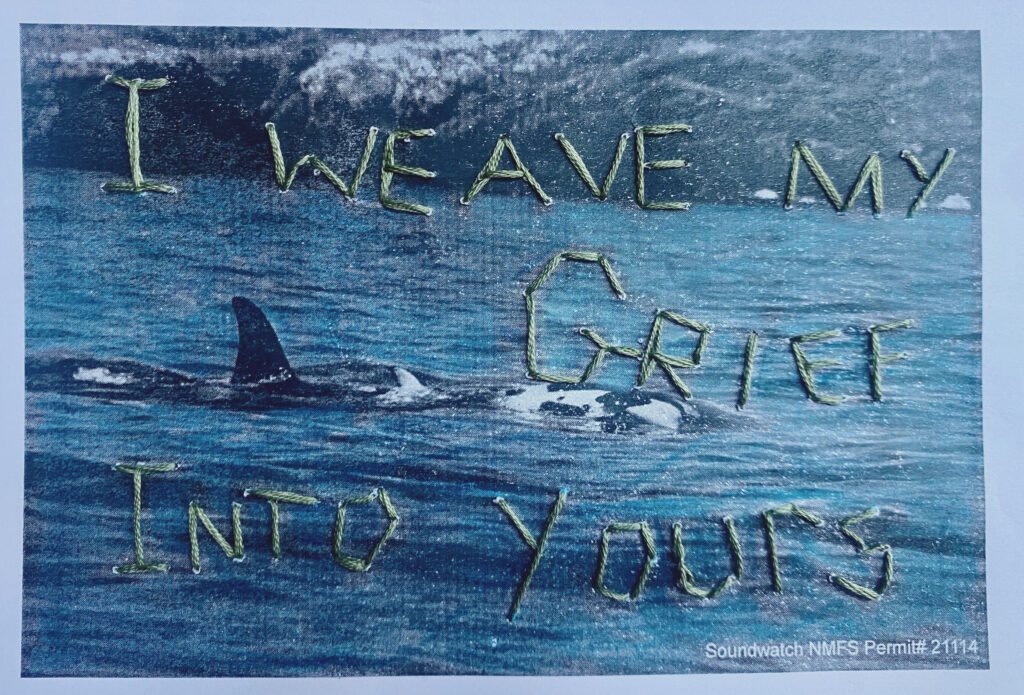
Laura Cull Ó Maoilearca, “I Weave My Grief Into Yours,” Embroidery thread on hand-tinted photograph showing the orca, Tahlequah carrying the body of her dead calf in 2018, courtesy of artist
How to cite: Comuzzo, Marie. “I don’t think you understand: Listening with Orca Tahlequah,” Listening With Whales, 22 September 2026, https://listeningwithwhales.org/poetic/#comuzzo.
I don't think you Understand: Listening with Orca tahlequah
Written, read, and created by Marie Comuzzo. See also erosic attuning and grieving with whales, and orcas.
This poem is my own attempt to listen with Tahlequah–the mother orca who lost her baby Tali 30m after her birth, after ca. 540 days of gestation–and tell her story of loss as though she was my chosen family and I was her chosen pod: writing about her as sister, ancestor, comrade. The more I study whales, the more I am moved by how they exist and how they resist so many of the categories that we humans create.
If you want to dive deeper with all the different references in the video, here is more information:
- Lots of the research on humpback singing has been focused on framing song as reproductive behavior. However, we have no evidence of that.
- The picture of the baby orca is Tali, Tahlequah’s daughter who died July 24, 2018, and her mother alongside their pod grieved her for 17 days. Their grief inspired massive cultural shifts and the ahlay’s creation of this incredible album: WAILS: SONGS FOR GRIEF, a portal to practice the kind of listening discussed. Since then she has lost another calf on December 31, 2025, just a few days after she was born.
- The following is the Puget Sound: their home. A terrible oil spill (Exxagon Valdez) in 1989 across the Prince William Sound almost entirely destroyed the ecosystem and it continues to have massive repercussions on their well-being. To understand the ecological trauma that surrounds these whale and human lives, read Eva Saulitis’s book Into Great Silence, where she traces the devastating effects that the oil spill had on orcas population and the relentless erasure of their families.
- Plastic is a huge issue for all marine mammals and Greenpeace created a whale art installation. For more see here.
- Recently, orcas were recorded for the first time French kissing.
- The southern resident orcas eat only salmon and the salmon population has been declining for years and years because of dams built at in the 1910s that prevent salmon to return to their spawning areas.
- Orcas off the coast of Spain have been taking down yachts and other boats, with over 500 recorded interactions without any harm done to the humans. First recorded in 2020, but that escalated in May 2023 when the orcas took down three boats. There are hypothesis that these stem from White Gladis’ leadership.
- Since then, the internet has been flooded with memes of people siding themselves with orcas against capitalism. Two of them are present here, made by @cocktailsandcapitalism & @puppers.against.capitalism ; and @grimwomyn. “become ungovernable” has a lot of layers that I invite you to explore.
- Black feminists & Native, Indigenous, and Aboriginal scholars have led the way to do this kind of work and talk openly about the systemic oppression that capitalism and extractionism causes. They have fought and continue to fight relentlessly against a system that tells them they are powerless and attempts to erase their important leadership and voices. There are so many people that have shaped this work, and in no particular order, especially, Audre Lorde, Alexis Pauline Gumbs, and Adrianne Maree Brown, Robin Wall Kimmerer, Jodi Edwards, and so many others.
- The two images following the dropping of the bombs are Gaza and Hiroshima, and of course there is also a citation of the epic fails of missile launches happening in 2025 and how much pollution and distress they are causing.
- The image of everyone coexisting in a circle (ECOCENTRISM) comes from a life-changing lecture I attended by Potawatomi leader, writer, weaver, and mother Robin Wall Kimmerer, who talked about the importance of seeing everything around us as living, animate, as kin.
- And finally, Rachel Moore’s “A Galaxy in Her Eyes,” the eye of Sweet Girl, a humpback gurl by @moore_rachel who deeply cared about her and made stunning portraits over the years as they swam together in Mo’orea, Tahiti.
After she was killed by a boat traveling three times as fast as it was supposed, Rachel was able to gather over 50,000 signatures to demand regulations on ferry speeds. And THEY WON. Now, there are strict regulations on speed, and marine biologists are always present on the ferries that bring people from Tahiti main island Papeete, to Mo’orea, to ensure that experts continuously scan the ocean for humpbacks, actively protect their lives. - The last picture is the eye of an orca but I couldn’t find more information about the photographer nor the orca.
How to cite: McVay, Scott. “Whales Sing,” Listening With Whales, 22 September 2026, https://listeningwithwhales.org/poetic/#whale-sing. Originally self published in Whales Sing and Other Exuberances. Uploaded with Scott and Hella McVay’s permission.
Whales Sing
Written by Scott McVay the day they discovered humpback whale songs structure (learn more in musically & historically).
Up and up and up the scale
beyond the topmost upper note
and beyond that
straining for ultimates
leaving a low wailing
a small sob before
and beneath
to the reachingest next-to-god note of all,
a Humpback sings his song.
The Song of Songs
The Hymn of Hymns.
No other creature
utters
a like fantasia
of arching highs and belly lows,
birds and bottom fish,
fishing each sound with the memory
of what’s gone before.
The “string-èd ensemble”
in the front of the head
tries out
a magnaproposition.
If some shrink before a remote
mind,
let them seek
his song,
let the universal binder
bind blind extinction and bind us anew.
His song shall unbend us
‘til we put away guns
and forget enough
to recall what counts.
I need these string-ed sounds of odd shapes
the way a body aches for spring
in February
So do I need the sounds
to swim and dream in
to float and bob and dream in
to ride and rest and sleep in
to coast and cradle and nest in.
I need the notes to swing by
and envelop.
if the whale’s voice be stilled,
then I shall be quieted utterly.
I have this tape
and I’ll listen
until I know each linked sound and
can play them all in
my mind whenever….
What man has not searched for the grail?
other grails of various shapes
nestle here and there,
yet let me say flatly —
no better song can be
only other songs.
I must know all songs
and their parts, and
this single great aria
will lead me through
other arches, cathedrals and gardens
of song.
Songs sung over a thousand rolls of the seas
and turns of sun and moon.
Songs to light the way
of lost men.
Songs to show the way
for lonely women.
Songs to answer
the laughter and song of children.
Endless trills and low notes
to strike each plane
of the inner surface of
life’s shell.
whalish Poetry books
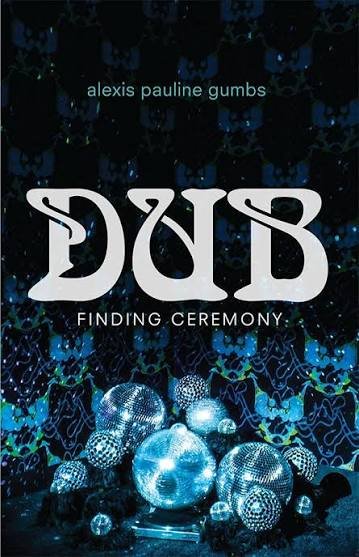
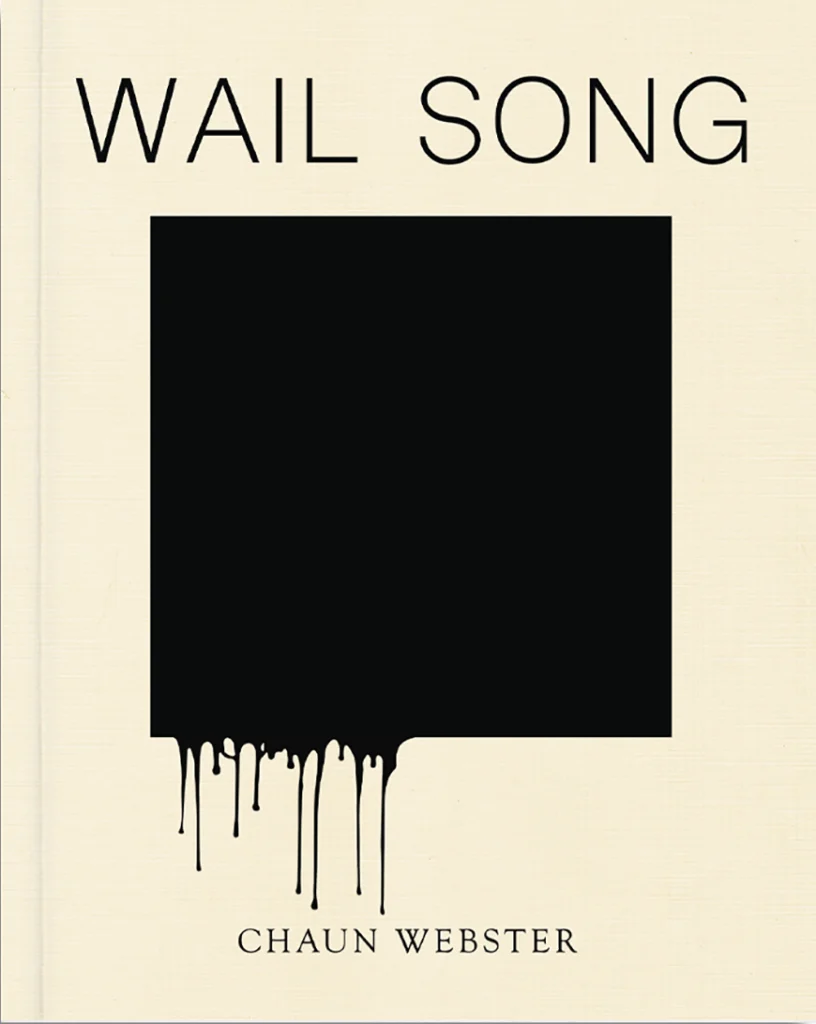
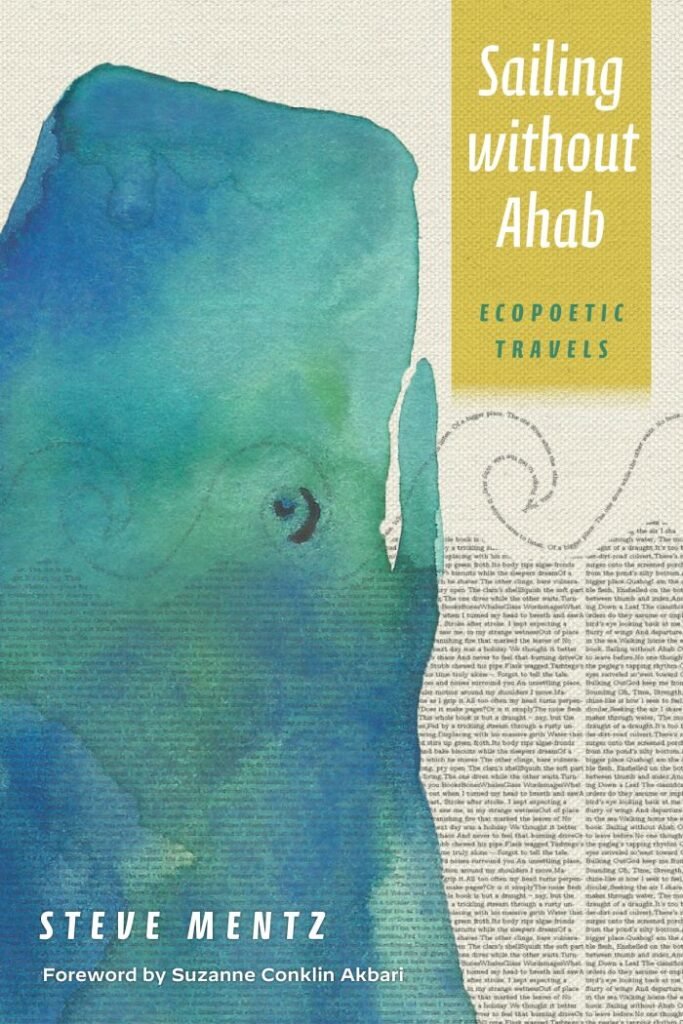
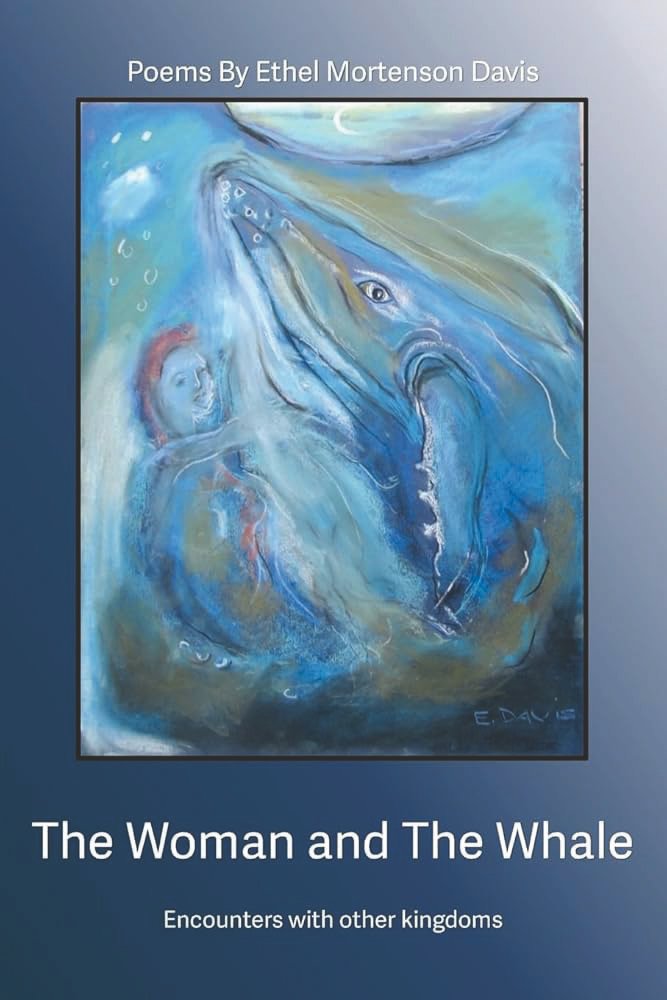
to be continued…
Do you have a whalish poem for the whales and those listening with them? Gift it to the current!
Did you catch a mistake? Report it for a krill!
Listening with Whales is a living, growing digital commons. Sing it out: share this page!