Written by Marie Comuzzo
How to cite this page: Comuzzo, Marie. “Humpback Whales,” Listening With Whales, 9 October 2026, https://listeningwithwhales.org/humpback-whales.
What does it mean for your song to fill the ocean and spread across through bone-deep touch?
Most famous for their songs, humpbacks have a somewhat solitary, reputation. Supposedly singing their songs only when alone, across migration, one wonders what aloneness means for a humpback: are you ever alone if your voice can reach another and touch them?
Rippling through as a bestselling hit, “Songs of the Humpback Whale” has transformed a collective that was, until that point, ruthlessly killing commercially whales. Because whales move across the whole planet and our planet is mostly water, until the late 19th century the ocean was the holder of much ancient wisdom. Across Oceania, Indigenous+ leaders reminds us of the incredible loss that commercial whaling caused. And so does the African diasporic community.
Because of the lack of culture and knowledge mixed with the endless greed for cheap wealth, countless elders and kin members were killed by a quickly spreading virus: a culture in pursuits of the kind of profit that dies quick and demands for more without ever giving back. Instead, it extracts, kills, demands, and erases something that can never be restored.
These collective losses—of humans and whales–are frozen in furious chests that move human people to rise, resist, and demand changes, collectively.
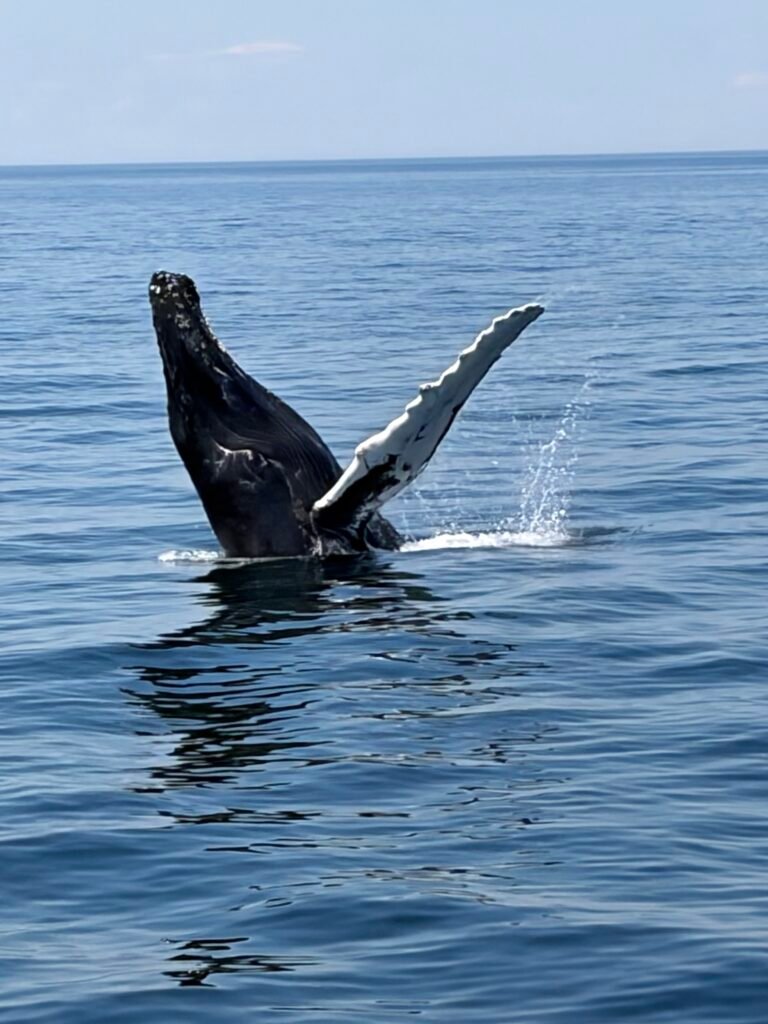
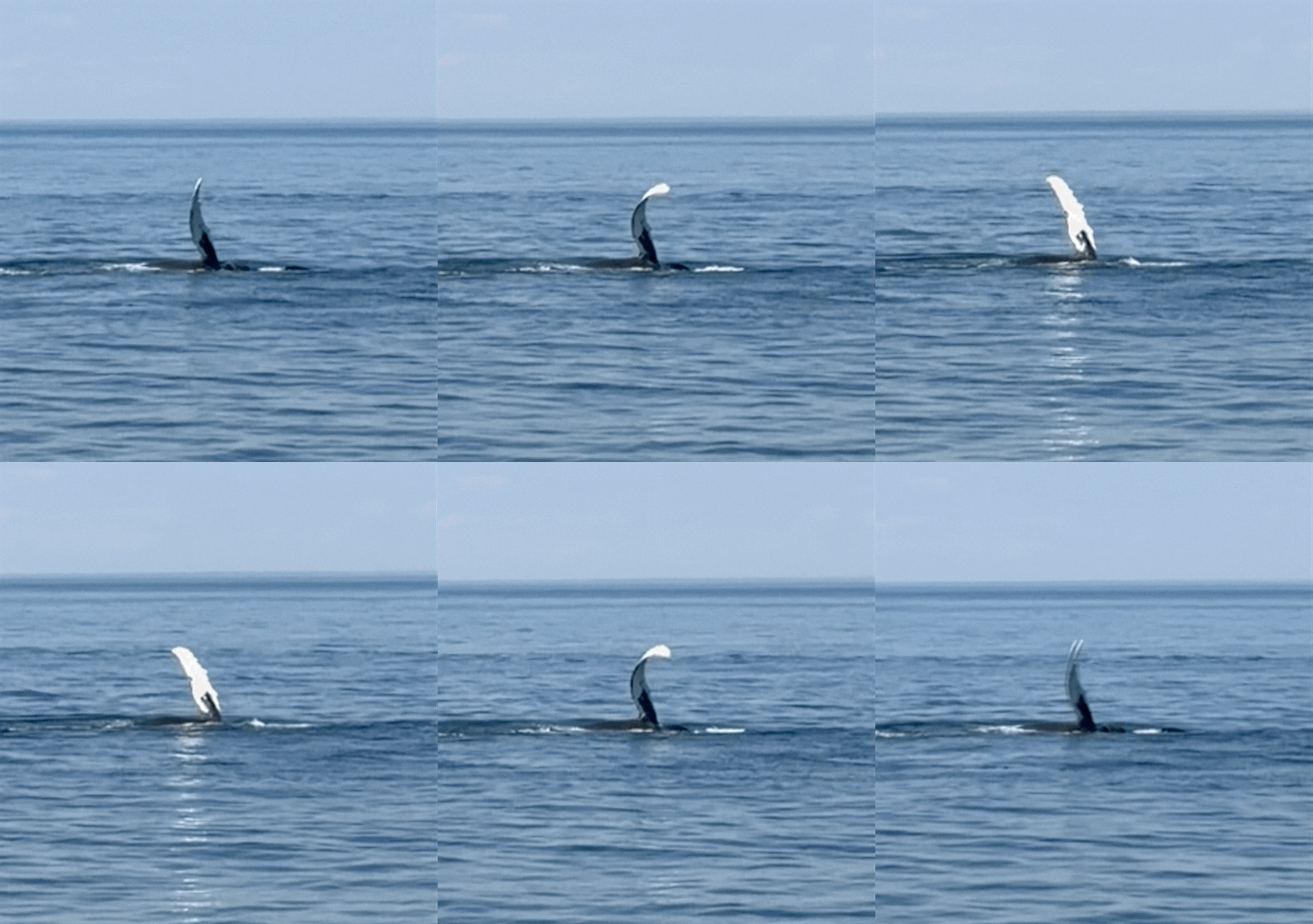
Photos take by Shannon Knudsen off Provincetown in Cape Cod.
New systems are born, others are being re-centered, which dislodge the status quo and demand reparation while pushing for more ancient systems to be part of the law. So, whales have recently obtained legal personhood. (see the Whale Personhood He Whakaputanga Moana declaration, the Moananui Agreement: pushed forward by many Indigenous+ leaders across Polynesia).
With their singing, their presence, their deaths, humpback whales have changed our music; our art, they have inspired poets and writers and scholars; new technologies, new sciences.
Across our need to know why they sing, and how they do it, we found a shared culture that is pushing for deeper forms of listening, and for a way of being on the planet that centers our obligation to one another.
Famous for their peace-building and protective qualities, humpbacks then may have and continue to inspire a bone-deep revolution through their musical touch, their gentle presence, and their mysterious ways that asks for a broader-reaching kind of listening.
Songlines of the Whales, recordings of East Australian Humpback Whales recorded by the Oceania Project (2026), and featured in WAILS: Songs for Grief (2024).
New Songs of the Humpback Whale recordings of humpback whales in Maui, Tonga, and Madagascar (David Rothenberg & Michael Deal, 2015)
Songs of the Humpback Whale, best selling nature recording of all time, featuring recordings of humpbacks off the coast of Bermuda (Roger Payne in 1970).
The Ocean Alliance Acoustic Library offers access to some of the oldest humpbacks’ recordings available and they share the files freely for educational and artistic purposes.
A longer recording offered by the CornellLab’s Macaulay Library.
This is a just a small sample of albums, learn more comprehensively about human-whale musicking & listening with a historical ear, and other forms of listening with humpbacks throughout the website.
While we strive to offer specificity about individuals, most recordings don’t offer identifying informations of individual whales. This is partially due to the difficulty of knowing who is the specific whale singing in the water, and partially because it took a long time to create an archive of whales flukes and tails (which is how they are identified). Check out for example, Naming Humpbacks (NOA) & the large archive hosted by Happy Whale of individual whales where you can submit your own picture to identify who you have met at sea.
Wanna add to the cultural history of humpback whales? Join the current!
Did you catch a mistake? Report it for a krill!
Listening with Whales is a living, growing digital commons. Sing it out!