Written by Eric R. Snyder
How to cite this page: Snyder. R., Eric. “Beaked Whales,” Listening With Whales, 16 September 2026, https://listeningwithwhales.org/beaked-whales. Photo caption: Ted Cheeseman, CC BY-SA 3.0, via Wikimedia Commons.

a diving record
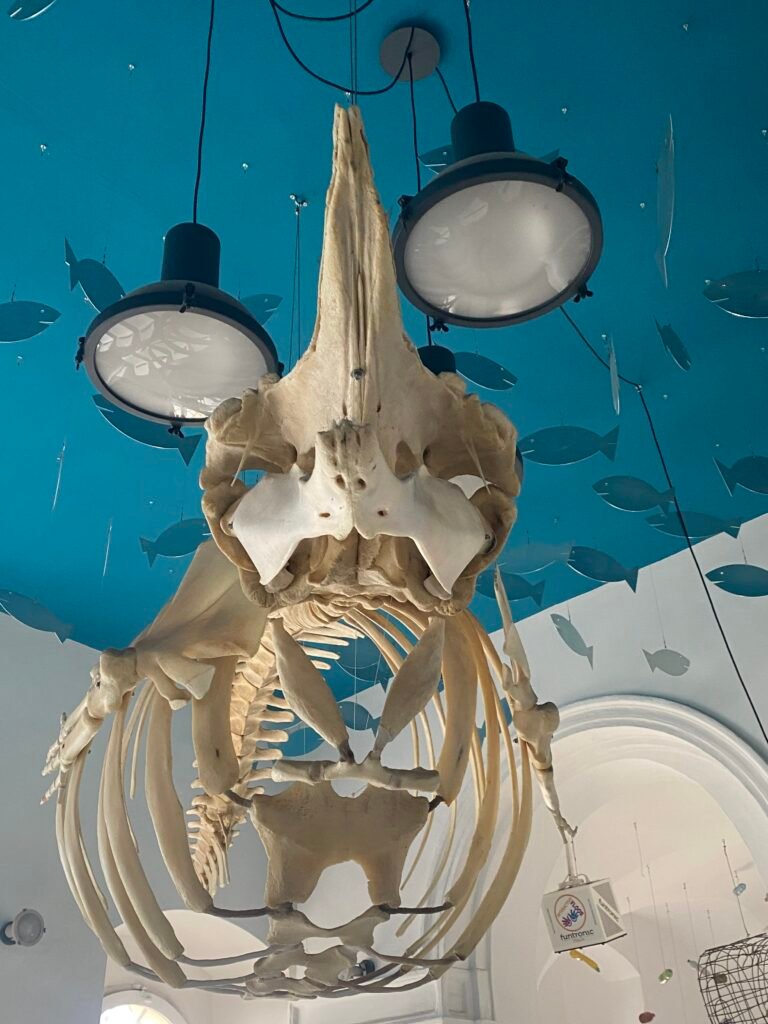
While technically “toothed whales” (odontoceti), only one species, Shepherd’s beaked whale contains a full set of teeth (Mead 2018). Most beaked whales eat soft-bodied animals like squid, making teeth unnecessary for feeding. The majority of beaked whales have only two to four teeth. These teeth often protrude outside the rostrum and are found primarily on males, leading many to believe they are used for male-to-male interspecies conflict (MacLeod 2018). One species – the strap-toothed whale – has teeth that extend from the lower jaw and curve completely around the upper jaw, forming a nearly complete loop (Strap-toothed whale 2026).
Beaked whales hold the record for both the deepest and longest dives ever recorded by a mammal or any tetrapod; in 2013, a goose-beaked whale with a suction-cup tag attached dove to 2992 m (9816 feet, or 1.86 miles) depth, and remained underwater for over two hours (Schorr et al. 2014).
Beaked whales are any of the 24 known species of whale in the family Ziphiidae. Despite being found in every ocean, their elusive behavior has made them notoriously difficult to observe in the wild. Several species are known only from corpses or strandings, and as recently as 2021 an entirely new species – Ramari’s beaked whale – was recognized by the Society for Marine Mammalogy (Carroll et al. 2021; MacLeod 2018; Society for Marine Mammalogy 2026). (Learn more about Iwi Ramari Steward here)
Goose-beaked whales are often referred to as “Cuvier’s beaked whales”, but in more recent years there has been an effort to change the common name to avoid referencing a man known for abusing Sarah Baartman and for his foundational influence on scientific racism. See the Marine Mammalogy Science call. (For more on challenging racism in marine science, check also out Black in Marine Science, founded by Dr. Tiara Moore and Amistad Press).
Listening to Beaked Whales
Due to their deep-diving and elusive behavior, passive acoustic recordings of their echolocation clicks have proved invaluable for studying beaked whale species. Many species can be identified by the distinct characteristics of their echolocation clicks. While there are still several species whose click-types are unknown (and recorded click-types that have yet to be associated to any known species), click counting has the potential to be used to estimate species presence, abundance, and population trends. (Baumann-Pickering et al. 2013; Hildebrand, Baumann-Pickering, Frasier, et al. 2015; Hildebrand, Baumann-Pickering, Giddings, et al. 2015; Li et al. 2023).
Acoustic localization involves using the time a sound arrives on multiple hydrophones to estimate the position of the whale that made the sound.
Researchers also deploy arrays of hydrophones localize beaked whale clicks and reconstruct their movements (Barlow et al. 2018; Gassmann, Wiggins, and Hildebrand 2015; Snyder et al. 2024; Wiggins, McDonald, and Hildebrand 2012). Acoustic localization involves using the time a sound arrives on multiple hydrophones to estimate the position of the whale that made the sound. These tracks provide crucial information for abundance estimation (detection ranges, probability of detection, how click intensity change depending on the orientation of the whale) and provides insight into diving behaviors (group sizes, foraging locations, correlation of oceanographic features to foraging regions, and more) (Baggett et al. 2025; Frouin-Mouy et al. 2026).
A few beaked whale species have been recorded making tonal sounds like whistles
Beaked whales regularly dive to depths where no light penetrates, making acoustics the primary sense with which they observe and experience the world. Like most toothed whales, they echolocate for navigation and hunting. Most of their clicks are above the hearing range of humans. Slowed-down and frequency-shifted recordings can be heard here and here. Most species emit two distinct sounds: clicks and buzzes. The clicks are typically emitted in regular intervals every 0.1 to 0.5 seconds. As a beaked whale approaches prey, it will begin emitting clicks in such rapid succession that the sound is more like a continuous buzz. Since these buzzes are presumed to be associated with prey-capture, they can be used to ascertain information about foraging depths and behaviors (Baumann-Pickering et al. 2013; Jarvis et al. 2022). A few beaked whale species have been recorded making tonal sounds like whistles (Aguilar De Soto et al. 2012; Dawson, Barlow, and Ljungblad 2013; Dunn et al. 2013). Also watch here.
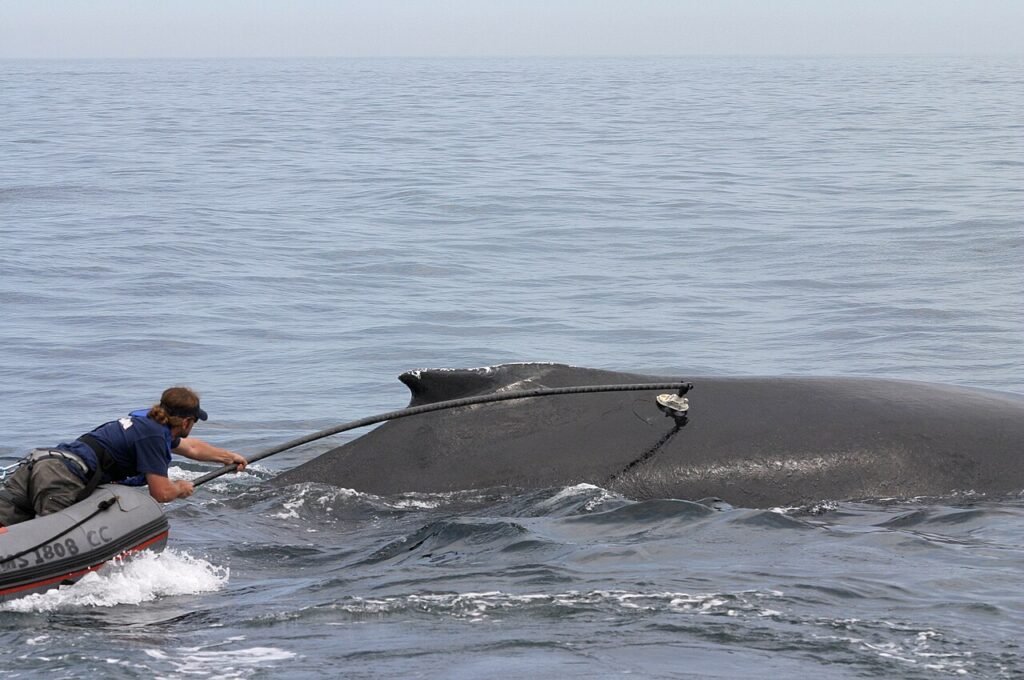
suction cups for deep research
Tags can be outfitted with satellite positions, depth sensors, and accelerometers for measuring the position, depth, roll and pitch of an individual. Tags outfitted with acoustic recorders have played a crucial role in understanding the vocal behavior and acoustic characteristics of several beaked whale species.
Suction cup tags have played a foundational role in studying beaked whales.
Acoustic tags have been the primary method for associating sounds to the species that make them, as well as providing critical information about dive depths, and responses to anthropogenic sounds (Aguilar De Soto et al. 2012; Dawson, Barlow, and Ljungblad 2013; Dunn et al. 2013; Johnson et al. 2004; Miller et al. 2015; Schorr et al. 2014; Tyack et al. 2006; Wensveen et al. 2019).
Threats and Conservation
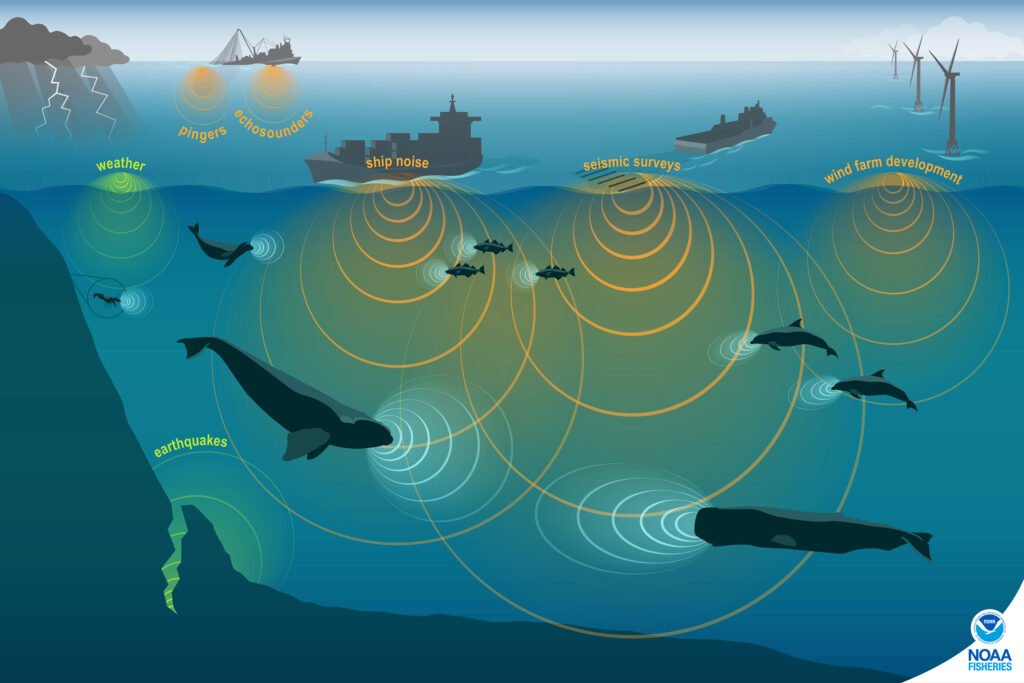
“Anthropogenic noise has devastating effects on an immense variety of underwater species causing disruption of important behaviours such as foraging or nursing behaviour but also physical damage and even death. “
Learn from Dr. John Hildebrand at Voices in the Sea about noise levels in the sea and how they impact cetaceans.
Military sonar and anthropogenic pollution
Several mass strandings of beaked whales have been linked to mid-frequency military sonar activity (D’Amico et al. 2009; Filadelfo et al. 2009; Hogarth 2001; MacLeod and D’Amico 2005; Simonis et al. 2020). In some studies, tagged whales were observed to change behavior in the presence of mid-frequency sonar, including swimming rapidly away from the sound, diving to record-breaking depths, and extending the duration of their dives (Miller et al. 2015; Wensveen et al. 2019). While the reasons for these responses are still an area of active research, the energetic cost due to avoidance of sonar is likely a threat to many individuals.
Beaked whales may be vulnerable to several other threats, including plastic ingestion, fishing activities, and climate change. However, the extent to which beaked whale species are threatened is still poorly understood: two beaked whale species have been classified as “least concern” by the International Union for Conservation of Nature, and all others remain “data deficient” (MacLeod 2018). Understanding each species’ distribution, population, and behavior is crucial to knowing how to better protect these remarkable whales and the unique impacts they have on deep-sea ecosystems.
Wanna add to the cultural history of beaked whales? Join the current!
Did you catch a mistake? Report it for a krill!
Listening with Whales is a living, growing digital commons. Dive it out!