Listening with Whales Artistically
Written by Florence Fitzgerald-Allsopp and Tessel Janse
How to cite this page: Fitzgerald-Allsopp, Florence, and Tessel Janse. “Listening with Whales Artistically,” Listening With Whales, 20 September 2026, https://listeningwithwhales.org/artistic. Photo caption: Mella Shaw, Sounding Line, 2024, Summerhall, Edinburgh, photo: Olive and Maeve, courtesy of artist
how are artists attending to whales through movement, dance, sculpting, making, weaving, and drawing?
In this text we are interested in how the creative, multisensory, and open-ended qualities of arts practice as a form of research, have the capacity to train bodies in different qualities of attention and produce knowledge alongside the nonhuman world in new ways. Reaching beyond listening musically with whales, we ask how artists today are attending to whales through movement, dance, sculpting, making, weaving, and drawing. We propose these artistic practices can be understood as expanded forms of listening.
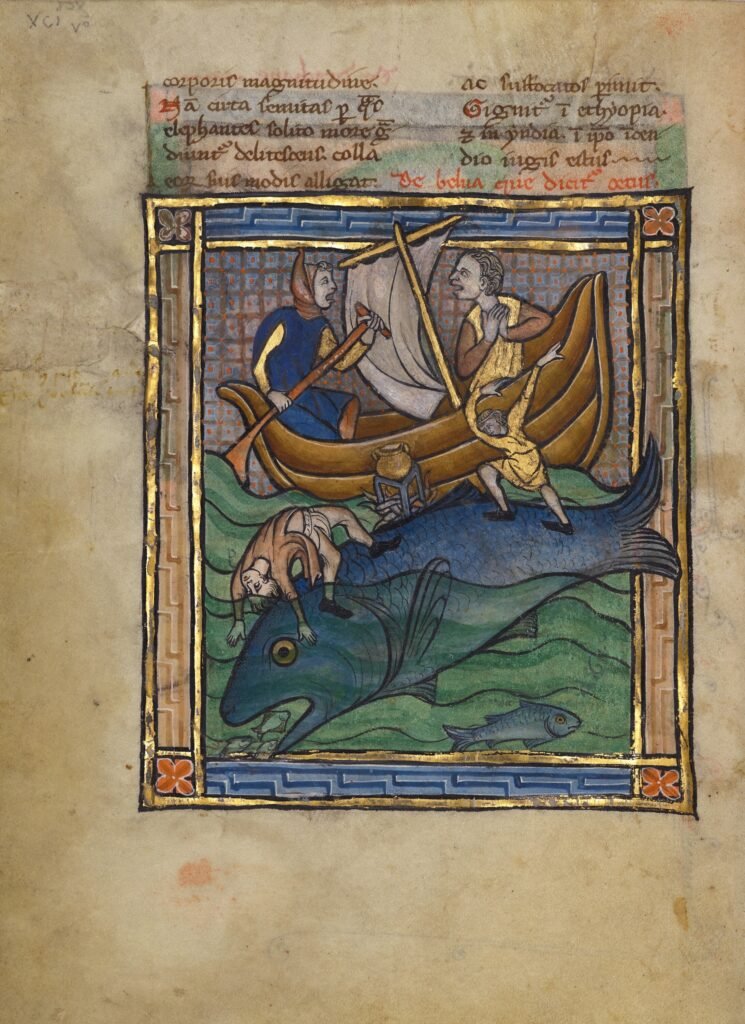
Whales are prominent characters throughout art history in many cultural contexts. Species both recognisable and fantastical, can be seen for example etched into ancient rock in Norway (c. 6000-4000 BC), carved into Nasca pottery (100 BC – 700 AD), and inked into the illuminated pages of medieval bestiaries in Western Europe (c. 12th-13th century). These depictions of whales suggest relations of reverence, subsistence, spiritual connection, and superstition, and speak to humanity’s changing relationship with the ocean.
In 16th and 17th century Europe whale beachings were a common occurrence, attracting artists and scientists alike. In the winter of 1601, a stranded sperm whale or cachalot lies on the beach near Wijk Aan Zee. The inhabitants of the small fishing village and nearby city of Beverwijk have come in their hundreds to behold the spectacle. Some traveled from Amsterdam or even further, making their way across the bustling beach in horse-drawn carts. Around the bloated body of the whale, members of the Dutch elite shield themselves against the cold December wind in their warmest clothing. Curious onlookers have climbed on top of the whale,
prodding their eye that looks blindly towards the sky. Near the tail, two men hold up a measuring tape. The Prince of Orange, his hat adorned with a large feather, presses a handkerchief against his face to avoid the stench. In the foreground, close to the whale’s mouth stands the artist Jan Saenredam, sketching.
Saenredam’s engraving is one of many images of beached whales that circulated in the Netherlands in the seventeenth century. They show how people tried to make sense of the arrival of such an otherworldly creature, understanding it simultaneously through recording all its physical details and interpreting it as a sign from above. Until whale carcasses began to be exhibited in 19th-century museums, they were only represented and imagined through tall stories of sailors, through images of their dead bodies – bloated and distorted – and through their bones, which were used to adorn Amsterdam’s Town Hall until 1652 or as landmarks or gravestones in coastal communities such as the Dutch island Vlieland. As a result, they were seen as fantasy creatures, as monstrously big fish, and, in this case, as harbingers of death and destruction.
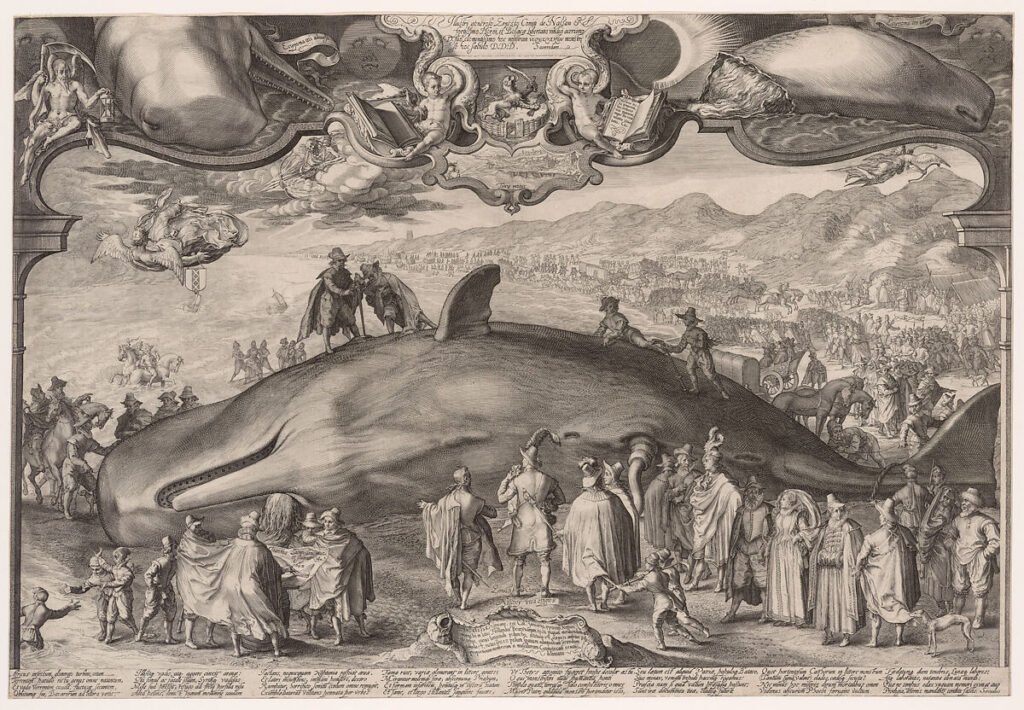
Jan Saenredam, Beached Whale near Beverwijk, 1601, 1602, engraving, collection Rijksmuseum Amsterdam.
The upper edge of Saenredam’s 1602 engraving, which is held at the Rijksmuseum Amsterdam, is decorated with baroque ornaments and figures. They indicate how the arrival of this ‘monster’ is to be interpreted as a bad omen. In the top left corner is Father Time, portrayed with an hourglass and a scythe. In the middle, a plaque shows a city plagued by a storm which is symbolised by a face, blowing wind from the sea. The city is moving on wagon wheels, with the inscription ‘terra motus’ below: earthquake. Shortly after the cachalot’s beaching, a solar eclipse, an earthquake and a lunar eclipse occurred, and the Black Death returned to Amsterdam.
a meditation, a provocation, an invocation
“This gestural act of washing the body of the deceased is evocative of cleansing rituals performed before funerary rites in various human religious cultures.”
Today artists continue to encounter the bodies of beached whales across the globe – an encounter laden with very different meaning in the context of late-stage capitalism and climate collapse. On the shoreline of Newfoundland’s Fogo Island in Canada, a former fishing community, lies another stranded cachalot whose decomposing body bobs back and forth in the shallow water. The Chinese-American performance artist Patty Chang stands alone before the whale, thigh deep in the water. She wears sturdy dark waterproofs and a beanie hat. In her gloved hands she holds a yellow household sponge which she soaks in seawater and sweeps in gentle arcs across the whale’s back. This gestural act of washing the body of the deceased is evocative of cleansing rituals performed before funerary rites in various human religious cultures, including Islam, Judaism, and Shinto. Here Chang extends this devotional act of mourning to the whale, subverting these human rituals to attend to and honour the death of an animal. This is performed to camera as a meditation, a provocation, an invocation, and entitled Invocation for a Wandering Lake (Part 1).
The whale is no longer understood as a monster or a bad omen, but as an awe-inspiring and intelligent social species who has survived centuries of harm, yet remains vulnerable in the throes of environmental crisis. Like Saenredam’s engraving, Chang’s artistic performance presents a different kind of cautionary message for modern times, a plea to her audiences to pay attention to the plight of these animals and their ongoing disappearance.
What does it mean to listen artistically with whales?
Invocation for a Wandering Lake is one of many contemporary artistic works that asks how humans might encounter whales in ways that resist anthropocentric (human-centered) relations, and find alternative ways of entering into different imaginaries. This can be understood as part of a growing interspecies movement in which artists are finding ways to think and create artistic work alongside nonhuman species, including animals, as part of a contemporary ecological ethic (eg. Interspecies Performance (2024), The Artist as Ecologist (2025). In this post we understand these artistic practices as another form of listening, and ask what it means to listen with whales artistically today. As demonstrated by this community, listening unfolds in many different ways. We are particularly interested in what human-cetacean relationalities and ways of knowing arise when listening is not restricted to the ear, but rather becomes an attentiveness that is embodied through performance, through dance or visual practices? How do these forms of artistic listening resist common portrayals of whales and their mythologies [Read Graham Huggan, Cetacean Quartet 2018], and speak instead to the lives (and deaths) of actual whales today and across time?
Listening beyond the ear
“As we improvise, compose, sing, and play with (whales), we learn to relate, attune, and listen with, we move beyond ourselves and learn from these giant beings”
Since the 1970s, as is well documented by other members of this community (see Listening Musically), the musical inclinations of whales and their sound-based worlds have been particularly alluring to contemporary human musicians. This has developed a genre of interspecies practice in which music is played either with or in relation to whales using hydrophone technology as a mode of listening and communication. Contemporary musicians including David Rothenberg, Jim Nollman, Michaela Harrison, Gry Bagoien, and Emily Doolittle have devoted themselves to co-composing live music with whales (and other more-than-humans) in various forms and contexts. These practices are distinct from projects in which musicians perform for nonhuman animals, in that the music changes in relation to the whales and vice versa as a collaborative improvisation. What these co-created musical practices have in common is that they make room for whales as musicians themselves, who possess the powers of creative agency and aesthetic preference. Moreover, they draw attention to the sound-oriented world of whales, helping us imagine the effects of noise pollution on their wellbeing.
Listening with whales through music is very influential and historically significant. It is well known that recordings of humpback whale song in 1970 inspired the ‘Save the Whales’ environmental movement, which drastically transformed human-whale relations in the Western world. But how might ‘we’ listen to whales beyond their music? (‘We’ in a non-universalising sense that acknowledges there are Indigenous people who have been listening to whales outside of European scientific or colonialist relations for centuries. See Listening with Whales Ancestrally) And beyond the ways in which dominant scientific research asks us to listen, particularly as enabled through technology (See Listening Scientifically)?
How can art change the way we relate to whales?
Listening through touch
This notion of listening beyond the ear can be approached through the work of transdisciplinary scholar Eva Hayward who, thinking alongside sensuous relations with marine animals, proposes that sensation is a distributed process both of the body and between species bodies (See Eva Hayward ‘Fingery Eyes’, 2010). For Hayward sensation is multiple in that, for example, to look is also to touch, to hear, to smell and to taste to different degrees. Her concept of fingery eyes proposes that the whole sensing body is implicated in the process of looking (see also Listening Diffractively). She writes “It is a visuality that requires the whole body, one with all its grappling hooks […] The moving and touching body becomes a visual apparatus, or the visual apparatus is the touching body” (See Eva Hayward ‘Ciliated Sense’, 2010). Similarly, the sensory experience of listening requires the whole body. The sensory world of toothed whales helps to bring this idea further into focus. Like other echolocating species (including some visually impaired humans), they see through sound, their sonic echolocation creating visual and spatial information about their environment (See Whiley & Day, ‘Multisensory Integration of Echolocation and Vision in Mammals’, 2019). For Hayward, sensation is also composed in relationship with others, spilling out beyond the body and between bodies.
Listening is not an isolated experience, but one that happens in contact with the world and in contact with other species. In this way listening involves an attentiveness to ecosystems as interrelated, and an attentiveness to how we are situated within them.
Returning then to Patty Chang’s Invocation for a Wandering Lake, it is the physical performance gesture of washing the whale’s body over time that enables a form of listening to happen – a deliberate and tactile attentiveness to what it means for a whale to die, to what whale death feels like, smells like, the salty acrid taste, the texture of decomposing flesh (see also Grieving with Whales). It is a listening to whale death that comes into contact with all other whale death, and the grief felt, by us, by other whales, and by the ecosystem (Read Laura Cull Ó Maoilearca’s work on whale grief here). In her more recent artist research project We Are All Mothers (2022), in collaboration with Astrida Neimanis and Aleksija Neimanis, Chang draws attention to porpoise death, and the scientific processes of animal autopsy. Again Chang introduces touch as a mode of attention, creating a ‘touch archive’ in which scientists are asked to document themselves spending a moment with their hand placed on the body of the porpoise before the autopsy is performed. This ritual of touch as a process of communal and interspecies mourning encourages scientists to “pause, reflect, and observe the purpose behind the procedures, incorporating intention and deep presence within the scientific method” (See more here).
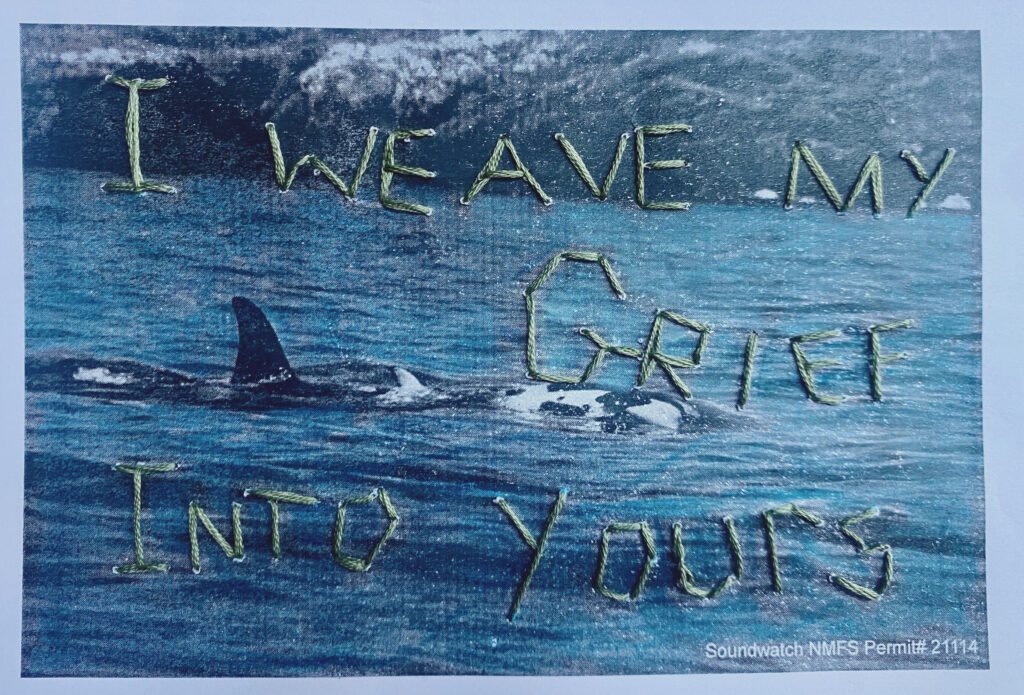
Laura Cull Ó Maoilearca, “I Weave My Grief Into Yours,” Embroidery thread on hand-tinted photograph showing the orca, Tahlequah carrying the body of her dead calf in 2018, courtesy of artist
These two projects, however, depend on proximity to dead whale bodies. Getting close to living whales presents all sorts of problems both practical and ethical; their watery environment is not habitable for humans, they don’t stay in one place, and they are overwhelmingly large. Furthermore, to track down and visit whales in their environment is complicated by the increased levels of marine mammal tourism, human disturbance, boat collisions, and noise pollution, that all impact the wellbeing of whales daily (See Sadie Hale, ‘Snorking with Orcas’, 2025). This also raises the question of whether listening to whales depends on their ‘availability’ to humans. This notion of animal availability – to be observed, touched, captured, killed – is embedded in ongoing colonial legacies which saw captive marine mammals put on display for human entertainment and profit (Graham Huggan, The Cetacean Quartet, 2018).
There are artistic projects, however, exploring alternative forms of relational encounter with living whales. These projects work to resist relations of constant surveillance, tracking and chasing, proposing instead more open-ended reciprocal encounters, making space for cetacean agency, mutuality, refusal, and consent.
(Learn also about non-invasive ways of collecting genetic sampling from whales and the ways it is changing how we study whales)
Dancing with cetaceans
“There is an emotional presence, which pushes hard or presses soft against you. You feel all of that in just the way they are taking you in – you see them seeing you, seeing them. Also, you can feel your own eyes expressing and their eyes responding. It pretty immediately feels like a conduit that’s as rich [as physical touch] and feels very similar”
One ongoing artistic project, led by Chisa Hidaka and Benjamin Harley, negotiates these complexities of artistic engagement with live marine mammals through The Dolphin Dance Project (2009 – ongoing). This is a collaborative dance project between humans and wild Atlantic spotted dolphins that takes place in a non-disclosed location off the East Coast of the United States, following a strict code of conduct including not touching, feeding, following, or disturbing the dolphins during times of rest. The project involves improvised movement sequences performed underwater alongside the dolphins who participate on their own terms, coming and going as they please. As many of us know, wild dolphins have an extraordinary enthusiasm and aptitude for choreographic performance (which has been exploited in captive contexts), but what is striking about this artistic collaboration is the way in which the dolphins adapt to human choreographic sensibilities and accommodate for human needs – primarily to return to the surface for air much more regularly than a dolphin would need to, but also slowing down in step with human speed of movement in water. As Florence has argued elsewhere, this project decentres touch as part of an interspecies ethic which resists the violence of capitalist colonialist histories – not without its quandaries (see ‘Entrapment & Empowerment’, 2024).
She suggests that the dancers opt instead to ‘remake contact’ with the participating dolphins through eye contact. Again, this can be thought alongside Eva Hayward’s somewhat disturbing yet sumptuous concept of fingery eyes, which speaks to the tactility of the ocular gaze (Read more here). Listening through eye contact, a shared movement language develops. As Benjamin Harley describes to Florence:
“[I]t’s very strange how clearly and directly that same kind of connection [as contact improvisation dance] seems to establish itself through eye contact […] you feel the same exchange of sensation, of pressure, of moving closer and further […] you’ll see [the dolphins’] pupils expand and contract as they are taking you in. There is an emotional presence, which pushes hard or presses soft against you. You feel all of that in just the way they are taking you in – you see them seeing you, seeing them. Also, you can feel your own eyes expressing and their eyes responding. It pretty immediately feels like a conduit that’s as rich [as physical touch] and feels very similar” (see ‘Entrapment & Empowerment…’, 2024).
This fascinating description from Harley speaks to a reciprocal listening through the gaze that strongly evokes the qualities of touch, and a form of knowing and relation articulated through shared movement.
To reiterate, this form of artistic relation did not happen overnight, the project has been ongoing seasonally for seventeen years with the same pod of dolphins– artistic listening across species boundaries requires time and getting to know your nonhuman collaborators.
However, this is another form of listening that depends on proximity to whales, as with Patty Chang, and as with the musicians who use the hydrophone as another tentacular device, or mechanism of aural ‘touch’ in proximity to whales. (See also Marine Chesnais and Kitty Mae Morris who are both dancing in relation to but with distance from cetaceans).
How are artists listening to and with whales in ways that don’t require proximity, yet are born through attention to our relational entanglements?
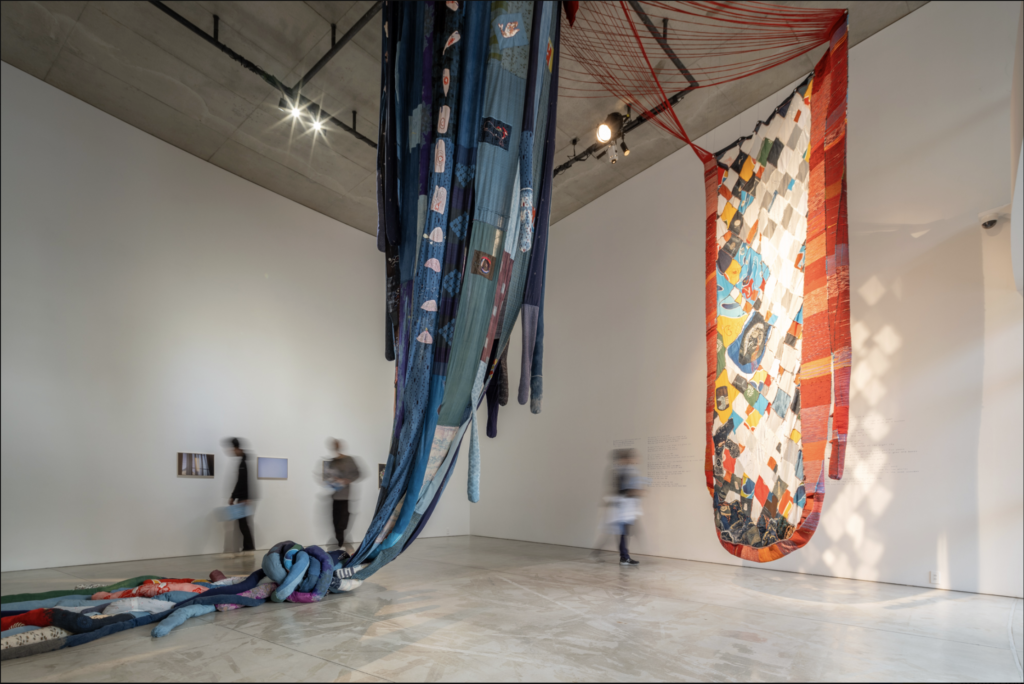
Sakura Koretsune “If twin whales appear in my dreams” Photo: Kuniya Oyamada
The bodies fit in my hand
Severed umbilical cords have no place to go
Eyes stopped growing before they ever opened
And they are hidden under thin skin
No wave heaves and no wind blows in a glass jar
Submerged in formalin, they are
Twin fetuses of white sperm whales
The calves never knew the sea
I try to recall the prayer for them
To return to their kin migrating from south to north
Torn cloth is rewoven, frays are mended stitch by stitch, and
Severed cords are retwined
Patchworking may make them live again
In another world where they will survive long
They will dive into the deep ocean and eat squid
They will beach themselves and be eaten
Offshore, they will meet
Cousins of the same age
The calves never knew the sea
I try to recall the prayer for them
To return to the lives that should have been
The poem above is the first part of a ‘twin’ poem written by Japanese artist Sakura Koretsune. It accompanies an installation of a patchwork cachalot hung from the ceiling at the Aomori Contemporary Art Centre, for the 2024 exhibition Currents/Undercurrents: Bringing Together Endless Flow. The tail is made of indigo blue fabrics, embroidered with smaller whales. The head, hanging nearby, consists of multicolour squares bordered by a band of red woven fabric, made according to the local sakiori rag-weaving technique. Koretsune, who studied Indigenous art at Fairbanks University, researched the bygone traditions of Japanese communities living close to ‘whale paths’, envisioning the importance of whales in people’s everyday lives and imaginations. Those who lived near migration routes received stranded whales – often elderly or ill – as gifts of food that gave rise to shared practices of celebration, distribution, collective cooking and consumption. The gift of the whale’s body also provided materials central to trade, traditions and crafts, with bones used for tools and buildings and teeth carved for jewellery, decorations and devotional items. When the whales disappeared, they took a strand of fabric with them that started unraveling a tightly woven structure of more-than-human relations. (see also Listening Poetically)
To reimagine the communal practices that were reaffirmed by the stranding of a whale – which happened on a more regular basis than we can imagine – Koretsune symbolically mended the weave that, through the body of cetaceans, bound humans to the sea. She held embroidery workshops and a collective cooking event with the community of Aomori, restoring a small part of the communal practices that emerged over time around whale strandings. Cooking mochi together and hand-stitching whales, sea birds and dolphins for the whale’s tail became an invocation of meditative attentiveness to the coming and going of the whales, the prayers for their return and for the good health of both the community and the populations of whales.
In After Efflorescence: Awakening the Whale Beneath Us, an installation for the 2025 Aichi Triennial, Koretsune made another cachalot. Hanging horizontally and consisting of multiple ‘flags’ of fabric, the whale’s anatomy is embroidered onto the surface. This anatomy, however, is not just its internal one. The ribcage contains multiple fish and seaweeds, but its forehead shows houses with smoke coming from the chimneys. Underneath the whale lie artefacts from a time gone by: ceramic vertebrae, parts of brick chimneys, whale bones and whale-bone tools that attest to centuries of connection to whales. After World War II, whale blood that was brought back from whaling expeditions was used in a ceramic glaze that allowed the community to rebuild economically.
In Koretsune’s work, listening with whales means to listen across history and to communities that transcend species boundaries. The widely circulated and influential narrative that listening saved the whales – the significance of which is described on this blogpost – directs our attention to a particular type of listening. This listening is not available to everyone, and has emerged only quite recently with the development of hydrophones and amplified sound. For centuries, however, communities without hydrophones have come to know whales in their own ways (see also Listening Ancestrally). As described in the poem, they built relations of dependence that led to intimate familiarity with whale bodies, required the ability to read signs of environmental health in the ocean and its species, and informed material cultures and collective practices of care. Now the whales have disappeared, these entanglements are often forgotten, and Koretsune invites audiences to remember, to mourn and to see how threats to whales from climate crisis, global shipping, pollution and rising noise levels affect not just whales, but also the weave that binds humans to each other and to their more-than-human surroundings.
Works like Koretsune’s demonstrate how art projects can listen to soundscapes of relations that exist beyond individual voices, and span across geographies and time. In addition to its reliance on specific technologies, the ability to listen for cetacean language or music through hydrophones has often inspired questions that boil down to ‘are they like us?’ and ‘can we prove their culture, language or intelligence?’. These questions evidence an interest in the voice as individual self-representation and, often, are built on the logic of similarity as a basis for human enchantment and worthiness of appreciation and protection. Moreover, ‘saving the whale’ becomes at least partially tied up in narratives that, as Graham Huggan writes in Colonialism, Culture, Whales: The Cetacean Quartet (2018), are ultimately about human redemption for whaling and extinction and less about the more complex challenge of how capitalism continues to threaten whales and the world around us. This focus on industrial whaling and listening to whales as a major cultural shift in the reputation of whales, thus speaks to some communities, their histories and desires, more than to others. Displacing listening from the ear to an attentiveness to how more-than human environments speak through changing ecosystem health, through the memories and material cultures of coastal communities, Koretsune invites us to let go of an arguably Western emphasis on individuality, instead seeking out forms of entanglement beyond the story of progressive understanding and protection enabled by technology.
In Iceland, the frequent washing up of whale bodies constituted its own ecosystem, their flesh becoming food for various land-dwelling species in an environment where other resources are scarce. It is not difficult to imagine the effect that the increasing absence of whales has had on multispecies whale scavengers across the Arctic. For her 2014-15 work Hvalreki, the title of which translates to ‘drifted-ashore whale’, Berber-Polish artist Sonia Levy spent time in Húsavík, Northern Iceland, to become familiar with their landscape of human-whale relations. When a whale came ashore, it signified good luck for the community, the whale’s treasures bringing economic fortune. Bones were used for construction but also charred to produce one of the earliest known pigments, called ‘bone black’. The bones of various species remain scattered across Iceland’s shores and are held in its museums. Levy cast the bones of fin whales in porcelain, which she used to conduct the voices of whales. In addition, she exhibited charred whale bones from the Húsavík Whale Museum, and drew images of whales with the pigments of their own bones. How, these works ask, do the voices of whales speak to us across time, through their residual bones that evidence a past abundance? How were whales once key to human survival, thus upturning commonly imagined hierarchies between humans and animals? How do they help us imagine what life and the land- and seascapes around Iceland sounded like before global industrialisation?
Both of these projects understand listening as an attentive act that can stretch across time, reinforcing the idea that listening with whales is not something contemporary or technological, but ancient, ongoing and expansive.
Decolonial Listening
“Creating interspecies encounters through sound, Ariel Guzik‘s work can be seen as an attempt to reintroduce ourselves to whales.”
From Koretsune and Levy’s practices of listening to cetacean voices as they emerge through history, and through human traditions and material cultures that may have been partly forgotten but not lost, we now move to Mexican sound artist Ariel Guzik’s approach to listening. Creating interspecies encounters through sound, his work can be seen as an attempt to reintroduce ourselves to whales. They are often set in places where ecosystems were polluted by industrial development such as the grey whale calving ground in Magdalena Bay, or where whaling intensely scarred cetacean perceptions of humans. Guzik builds instruments that translate the vibrations of environments – such as plants and rays of sunlight – into music by connecting them to extremely sensitive snares. Over the last decades, he developed a capsule named the Nereida, which can be lowered into the sea and responds to voices of whales and dolphins. The Nereida itself does not initiate sound. It softly chimes when cetaceans sing to it, becoming an instrument for them to play with, a gift from humanity to bring something of shared beauty. On different occasions, in Costa Rica, Scotland and even the Ganges River, various species of cetaceans such as humpbacks, grey whales and dolphins have surrounded the Nereida and played with it for hours.
who else is listening?
Despite the installation including no audible sound, Shaw invited audiences to listen in a different, more whale-like way.
To listen with whales artistically is a reciprocal process, one that recognises that whales too are listening to us from great distances, as are many other species.
The word ‘audience’ is derived from the Latin audientia, which means ‘a hearing or listening’. In this way artistic audiences expand beyond the human to all those listening, collapsing species boundaries. Particularly for those artists listening with whales musically, ‘who else is listening?’ becomes an ethical question, one that requires taking responsibility for one’s frequencies. It also requires considering the possibility that whales and other species may not want to listen, especially as their underwater world and wellbeing is already being catastrophically impacted by sound.
It is thought that a toothed whale’s inner ear bone, a dense listening structure not attached to the skull for localised hearing, may be fractured by high decibel sonar (watch Mella Shaw’s artist talk). In 2018 a mass beaching event in the Outer Hebrides saw the bodies of around 75 whales lying on the shorelines of the Western Isles. The majority of these whales were Cuvier’s beaked whales, the deepest diving of all marine mammals. It is suspected that the cause for these deaths was military sonar which frightened these deep diving whales and forced them to surface too quickly, possibly causing decompression sickness. Having witnessed this mass beaching first-hand, British artist Mella Shaw’s project Sounding Line (2023), invites human audiences to attend to how whales listen, and the catastrophic effects of marine sonar. Her sculptural installation includes various ceramic sculptures based on the amorphous form of a whale’s inner ear bone (which vary drastically in shape and size across species). Like bone china, which uses cow bone, these strong yet fragile sculptures are made from a clay mixed with the bones of a Northern bottlenose whale, who died after exposure to sonar pollution on the west coast of Scotland. The sculptures are wrapped and suspended by a red rope, or sounding line used to measure the depth of the seabed.
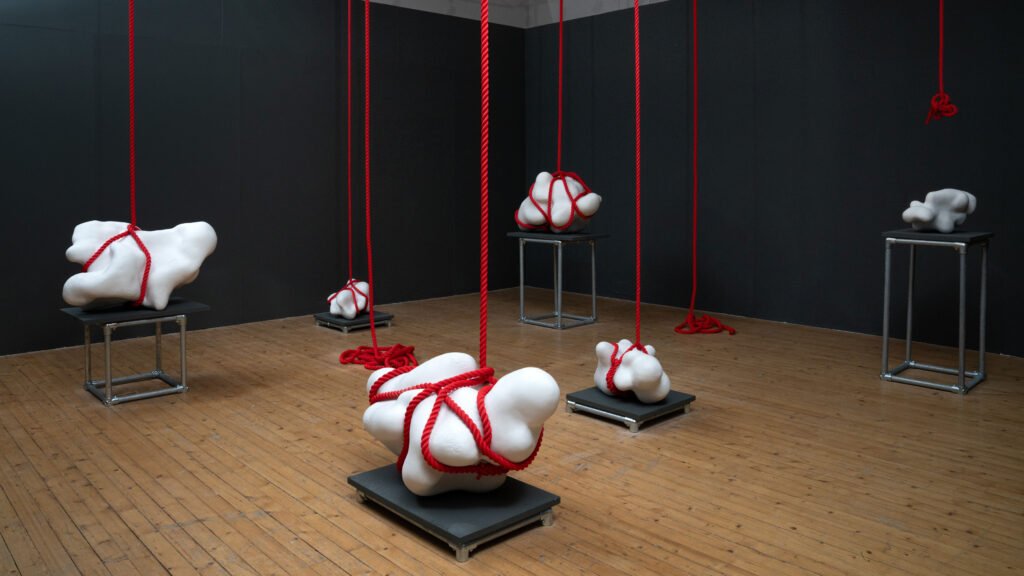
Mella Shaw, Sounding Line, 2024, Summerhall, Edinburgh, photo: Olive and Maeve, courtesy of artist
When these ropes, or ‘sounding lines’, are held by members of the audience they feel a pulse travelling through their bodies. These vibrations are created by channeling mid and deep water sonar recordings as well as shipping sound pollution through the rope. By producing a sound-based experience felt through the grappling hooks of the listening body, Shaw invites audiences to attend to how echolocation and sound might be experienced by whales (see also Listening Diffractively with Whales).
This is an example of how listening artistically can invite audiences to attend in more affective embodied ways to the lives and deaths of whales, drawing them into alternative imaginaries that move beyond the conventions of mythology and technology.
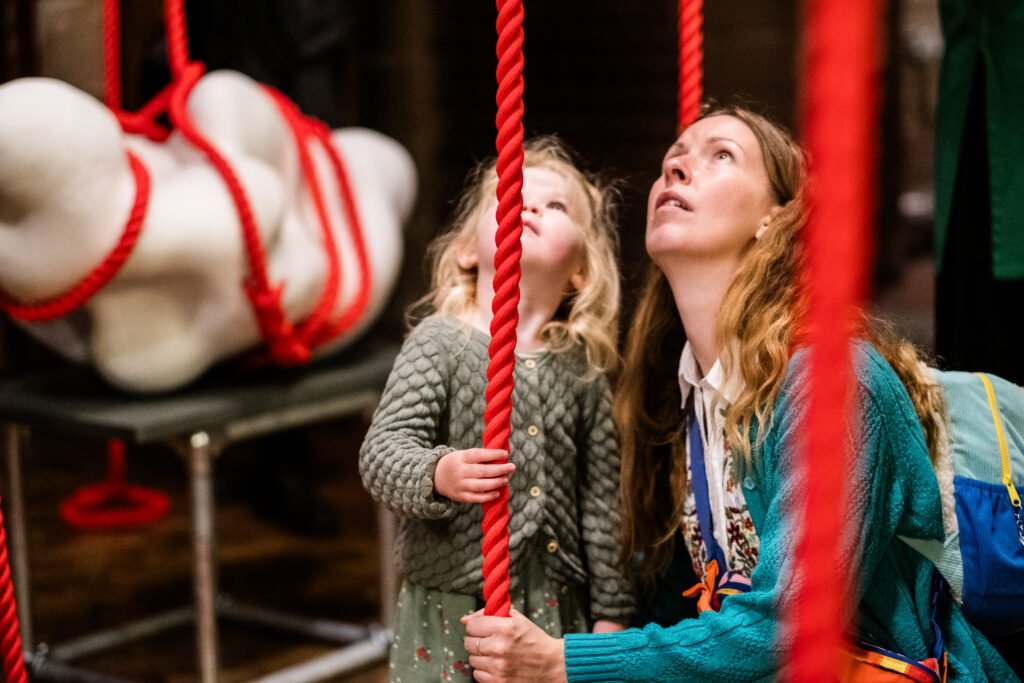
Mella Shaw, Sounding Line, 2023, British Ceramics Biennial, photo: Jenny Harper, courtesy of artist
Closing Speculations: Whales as Artists
What would it mean to think of whales as creative agents who, like human artists, invite us to become attuned to detail, to unfamiliar perspectives, to ways of knowing that might be ‘other’ to what we’re taught counts as truth?
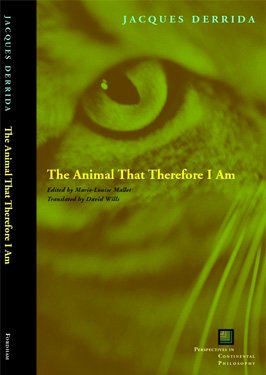
Artistic practices, as above, can pose open-ended questions that inspire imagination, perhaps even enchantment, without falling into the trap of demanding a definitive answer. It is this type of knowing, sensing and speculating that we need to get comfortable with, if we want to truly appreciate what it means to share the planet with beings that will never, as Jacques Derrida famously wrote in The Animal that Therefore I Am (2008), unequivocally respond.
Both artists and more-than-human animals communicate with us, but do so without allowing their audiences certainty. It is this uncertainty that is capable of upending the human-animal hierarchy: confident classifications of whales as charismatic, human-like, intelligent or cultured in the end return us to Glissant’s ‘knower’ who measures, decides, and interprets. What omen, then, are we to see in their beaching?
In Patty Chang’s work, the beaching of a cachalot becomes a speech act of a more-than-human environment in crisis. Here, the whale speaks through the plastic in their belly, their disoriented migration, or as in Mella Shaw’s work, their fractured inner ear bones.
Through the whale’s starved body, the food chain of plankton, fish species and squid also speak their absence. The water speaks of its toxicity through the chemicals stored in the whale’s blubber. The shore and its dwellers might tell us how long it has been since a whale washed up and brought nutrients to land. Koretsune and Levy’s installations become listening mirrors, bridges across time that allow us to listen through past practices of care and community. Shaw’s sounding lines remind us that listening is of the body, and happens across and in between species, as Hayward theorises.
In Guzik’s encounters, as in the Dolphin Dance Project, the curiosity of cetaceans as perceiving and expressive subjectivities with aesthetic interests and preferences tells us of the possibility to rebuild and create, that it is never too late to reintroduce ourselves and activate old and new forms of entanglement.
What whalish art, artst, creative encounter, exhibition, or performance may we invite to flow in? Add them to the current!
Did you catch a mistake? Report it for a krill!
Listening with Whales is a living, growing digital commons. Sing it out: share this page!