Becoming Friends with Trees
Written by Lena Dedyukina and Marie Comuzzo
How to cite this section: Dedyukina, Lena, and Marie Comuzzo. “Becoming Friends with Trees.” Listening With Whales, 22 September 2026, https://listeningwithwhales.org/currents/#becoming-friends-with-trees. Cover image: “Person Becoming Tree,” sculpture made by Marie Comuzzo, and photographed with an oak from their backyard in CT.
What practices can bring us together across differences, befriending the land, the water, and the new places we come to and gather in?
Across migration, belonging, and longing for a better future, we, Lena and Marie, found similar practices to get to know the land that we were coming into. We both came to these practices independently, when we respectively moved to Canada and the United States. Lena, born in Yakutsk, the capital of the Republic of Sakha, or Yakutia; and Marie, born in Bologna, Italy, from a mixed Italo-German Jewish descent family. Our experiences of being born and then living in predominantly patriarchal and white countries hold some similarities.
OUR PATHS, OUR RIVERS
Lena mainly spoke Russian, despite her parents speaking predominantly the Sakha language, growing up in a small Arctic town with long winters from October till May, polar nights when the first rays of the sun in mid-January are celebrated, and polar days with a never-setting sun for about two months. Lena’s childhood was filled with listening to Sakha tales, eating freshly cooked traditional small fluffy pancakes (oladyi) during long winter nights, collecting shiny river breakup ice in the spring, and lingonberries (sometimes called Arctic cranberry) and blueberries in the fall.
Marie’s childhood was divided between Bologna, Berlin, and Friuli, in the upmost north-east part of Italy—while I am grateful now for this multicultural exposure, as a child, I never quite belonged: in Bologna I was the German, in Berlin, I was the Italian, and in Friuli, I was the “city girl.”
Marie’s grandmother lived close to the land, coming from a family of farmers tending to silkworms, a fruit orchard, and larger crops. When visiting in the long summer months, my grandmother and I woke up early to gather the abundance. I especially loved climbing the generous figs, full of purple, soaring sweetness, before the sun hit them and the enormous wasps would buzz with frenzy in their galore. We would also tend the geese and the chickens, collecting their warm gifts, which they celebrated with vociferous announcements.
Learning Friulano from my nonna, over slow summers were boredom filled me with creativity, and I spent most of my day drawing at the kitchen table, observing my grandmother leaning over a heavy iron caldron, and turning, over and over, a bubbling golden liquid. Wooden fired polenta accompanied by hard cheeses was for us a delicacy, but had been a burden for my grandmother, who made it, in her youth, every day, three times a day, for the large household of workers. In those days, I absorbed the long stories my nonna would tell me: I learned how the constructions of the highway had paved away the gorgeous canyons of the river Natisone, whose refreshing pools had helped ward off the incessant heat of the pressing sun for generations before. I learned how the second world war and the battles against fascism that my family fought marred the land, wrecked apart families, and infused collective trauma in communities that live a simple but genuine life of reciprocal care. A trauma that I also inherited in my body and through stories of migration, forced to escape under regimes that erase our culture.
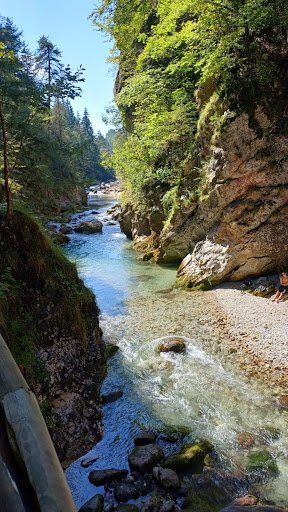
The Natisone in Fruili, one hour away from my grandmothers’ house, since the highway destroyed the river’s natural pools, they need to drive far to be able to swim.
La nonna was often crossed about our neighbors speaking only Italian to their dogs and human children. She hated it. It crossed her in a way I didn’t understand back then. She was noticing how, little by little, her language was being replaced by Italian, a formalization of a language predominantly rooted in the Tuscan dialect. These moments remained impressed in my young self, who found immense joy in words such as “chut tu cu sep’io?” (how on earth am I supposed to know) or pass me “il pecciot” (the rag). I still hear those phrases in my inner ear, and they make me smile, thinking of a past where I could still hold another language. Along the way, English took that space, and as my trips became shorter and less frequent, my thinking and speaking in Friulano flowed away.
I, Lena, learned the Sakha language without any formal training. Every two years, my parents took me to visit relatives on my father’s side in Bayaga, a small village in Tattinsky Ulus in more central Yakutia. There, everyone spoke Sakha, and I felt somewhat like an outsider, with local children making innocent jokes about my Sakha language abilities. Despite that, I loved spending summers there, surrounded by nature. My uncle had a small farm with cows, pigs, and chickens. The house we stayed in had a big backyard where I collected wildflowers, chased grasshoppers, and learned to ride a bike. I had several uncles, aunts, and cousins living in this village, and I spent my summer holidays playing with my cousins, swimming, picking berries, learning to milk the cows, visiting relatives, and eating tasty traditional food. These moments of simple village life are something I cherish even more now, being away from the land, the people, and all the relations that are part of me. However, I have to be careful not to romanticize these relationships while staying attentive to the political, economic, ideological, and sociocultural forces that shape our lives.
Similar to Marie, I came to understand that my body also carries an inherited trauma, pain, and loss about which I wasn’t aware before. Throughout my school years and into early adulthood, I never had an opportunity to deeply engage with questions of colonization or to understand how colonial histories shaped and continued to shape the story of my people. I was never taught to ask these questions, nor did I have the language to articulate them. However, a sense of unfairness and moments of resistance always stayed with me, even though they were suppressed by state narratives of friendship among nations and the supposedly peaceful incorporation of Indigenous peoples and their lands into the Russian state. Only much later, while living thousands of kilometers away from where I was born, did I have a chance to think about these histories that are not simply something belonging to the past, but also present now and continue to shape relationships, perspectives, and memories.
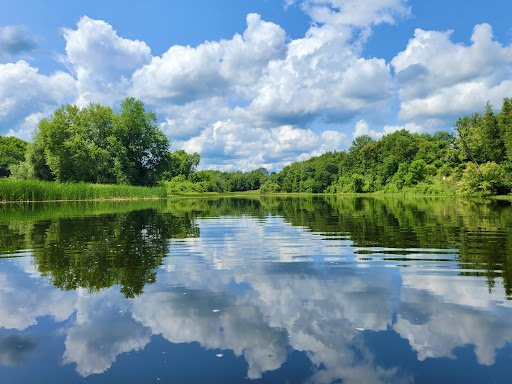
Mississippi River in Ontario, Canada which is not related to another Mississippi River in US. For me, Lena, the picture reflects the sense of belonging: flowing calm water, bright green trees along the shoreline, blue sky and fluffy clouds mirrored on the surface of water.
In our youth, we were immersed in the study of Mozart, Beethoven, Prokofiev, Bach, and Vivaldi; and readings of Pushkin, Mayakovsky, Dostoevsky, Tolstoy, Lenin, Eco, Dante, and Mann; and learning the thought of Freud, Descartes, Nietzsche and Kant. Through our respective lessons in piano and violin, and the many hours spent in school, we were educated into dominant German, Italian, and Russian national cultures and joined the apprenticeship to the “Great Masters.” These cultural traditions were profound and important to us, yet the canons through which we encountered them were also shaped by imperial, nationalist, patriarchal, sexist, and racialized hierarchies that established particular cultural expressions as universal, while rendering the cultures closest to us provincial and minorized
Thinking WITH TREES
The 2026 4th Environmental Peacebuilding Conference brought us together by learning about each other’s work (Lena’s “Learning to Befriend a Tree” and Marie’s “Grieving with Whales & Erosic Attuning”).
In Sakha culture, Aal Luuk Mas (the Tree of Life) represents the harmonious circulation and continuity of life, an epistemological and ontological worldview that does not separate humans from the natural world. Humans, other-than-human beings, spirits, land, and ancestors are interconnected through the roots, trunk, and branches of the tree. From this perspective, the tree is more than a symbolic representation. It reflects an understanding of life grounded in relationships, where humans exist as part of a broader living network rather than above it.
The Tree of Life is not simply a symbolic structure connecting different worlds (lower, middle, and upper) but a living presence, often represented as a female spirit associated with life, nourishment, and protection. This understanding reflects a wider Sakha worldview in which spirits inhabit the world, and humans have to maintain ongoing relationships with them. These relationships carry responsibilities. Different spirits, such as the spirits of the forest, water, fire, and others, must be acknowledged and treated with respect, including through offerings. For example, feeding the fire with pieces of the best food or leaving colorful strings on the branches of the sacred tree. Such practices require people to express reciprocity and recognition of the land, entering into relationships grounded in attention, gratitude, and care.
When still in Italy, Marie’s immersed in the teachings of the Kabbalah, particularly in Igor Sibaldi’s translation and interpretation, often represented by עץ חיים, (Etz Chayim: the Tree of Life). The tree, rooted and branching out, conceptualizes the relationship between different forms of existence, but also the entangled paths of existence manifested in the psyche, the body, and invisible forms of knowing. This encounter was a first seed toward thinking with trees; and these teachings led me to pay more attention to trees in their material presence. When theory became practice, rational learning became relational attunement.
La nonna was often crossed about our neighbors speaking only Italian to their dogs and human children. She hated it. It crossed her in a way I didn’t understand back then. She was noticing how, little by little, her language was being replaced by Italian, a formalization of a language predominantly rooted in the Tuscan dialect. These moments remained impressed in my young self, who found immense joy in words such as “chut tu cu sep’io?” (how on earth am I supposed to know) or pass me “il pecciot” (the rag). I still hear those phrases in my inner ear, and they make me smile, thinking of a past where I could still hold another language. Along the way, English took that space, and as my trips became shorter and less frequent, my thinking and speaking in Friulano flowed away.
Tree of Grave/עץ הקברים
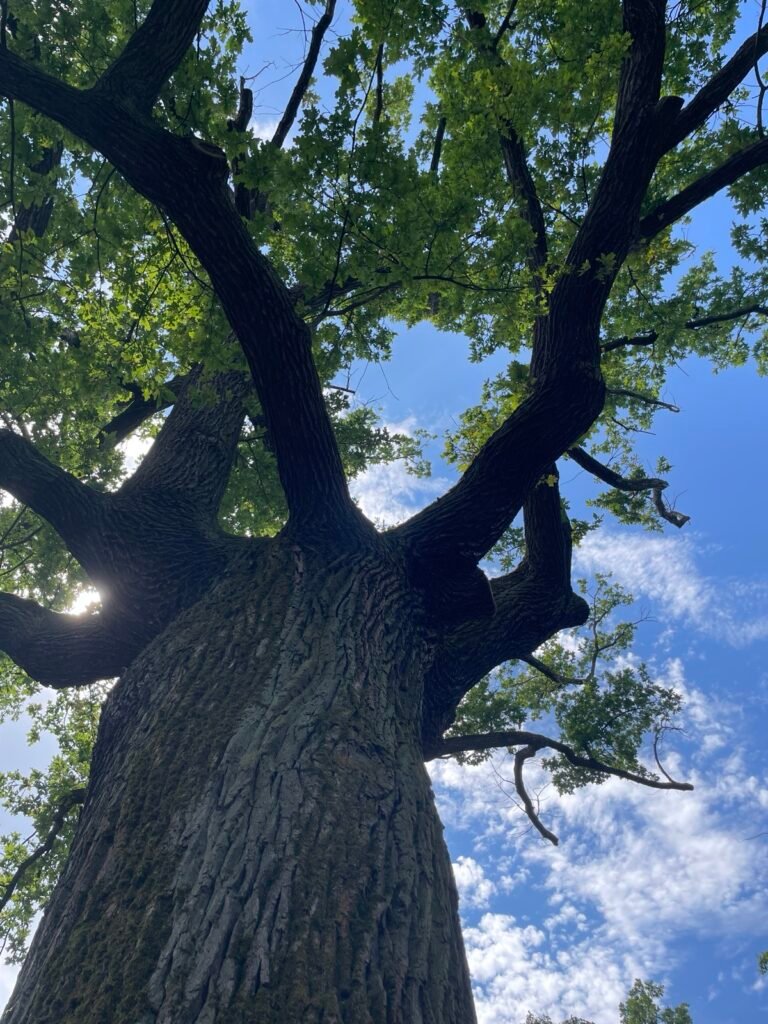
Song by AYAH, composed by listening with the oak here below, and photographed by Ayah.
La’Ruach
Al geza yatsiv
Bo’i lanu’ach
Be’in ha’alim
Sodot lochashim
Le’at, le’at
El lev adama
Kmehim shorashim
Kacha gam at.
To the wind
Against a stable trunk
Come and rest.
Between the leaves
Secrets whisper:
Slowly, slowly
Roots yearning to reach the
heart of Earth-
Exactly like you
BEFRIENDING TREES
For me, Lena, friendship with trees became a part of my life during Covid-19 in 2020, when I lost my father and couldn’t go to the funeral because of the pandemic lockdowns. During one of my neighborhood walks, a birch tree caught my attention. It stood close to the trail, kind of leaning toward it. I stopped and put my hand on its trunk. I don’t know why, but I felt better after that encounter, and ever since, I always make sure to visit my friend.
After several years, while working on projects and thinking about my position as a researcher and graduate student engaging with topics related to Indigenous peoples, I came across a call for submissions on biocultural diversity. This led me to write a reflection piece about befriending a tree. I now have another tree friend in my neighborhood. It is a pine tree, and with this friend I can sit and spend time together. It is not always possible with my birch friend, because I always feel awkward standing near the tree on the public path. Nevertheless, I always make sure to stop and greet the tree when I’m walking by, and it makes me feel better. And of course, I have a beautiful maple tree growing in my backyard. It’s not just a friend now, but a part of my family.
As a first-generation immigrant, Yakut (Sakha) woman currently living in so-called Canada on the unceded Algonquin Anishinaabe land, calling trees my friends has led me to consider belonging differently. In this sense, I’m not necessarily rooting myself in one place, having been uprooted already several times, but rather by recognizing relationships as networks that extend across lands, waters, species, and memories.
This understanding also resonates with my name, which is connected to the Lena River that flows across my homeland, Yakutia, from the Baikal Mountains to the Laptev Sea of the Arctic Ocean. Like the Lena River, or any river flowing toward a larger body of water, whether a lake, sea, or ocean, relationships can travel across places, carrying memories and connections with them while also being transformed along the way. Sometimes, distance makes what once seemed ordinary more visible.
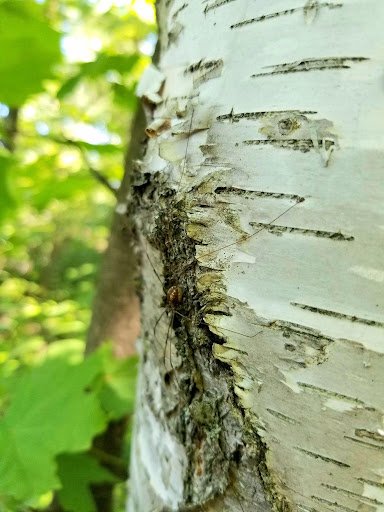
“Birch friend and a spider.” Photographed by Lena.
I didn’t see the spider at first, but when I realized that it was there, I tried to capture it in this picture.
When I, Marie, first came to the so called United States, I was in awe of the enormous trees and the moist forests covered in the softness of mosses that caressed my bear feet. My aunt lived close to East Rock in New Haven, and I loved climbing up the stairs and see the whole city from above. One day, when I was seeking a place to sit, an oak called to me, and I sat leaning onto their trunk and held by a cradle that somehow perfectly fit me when I sat. I returned every day, to be held in their presence, and later, when I moved, I returned to greet them, when I was back.
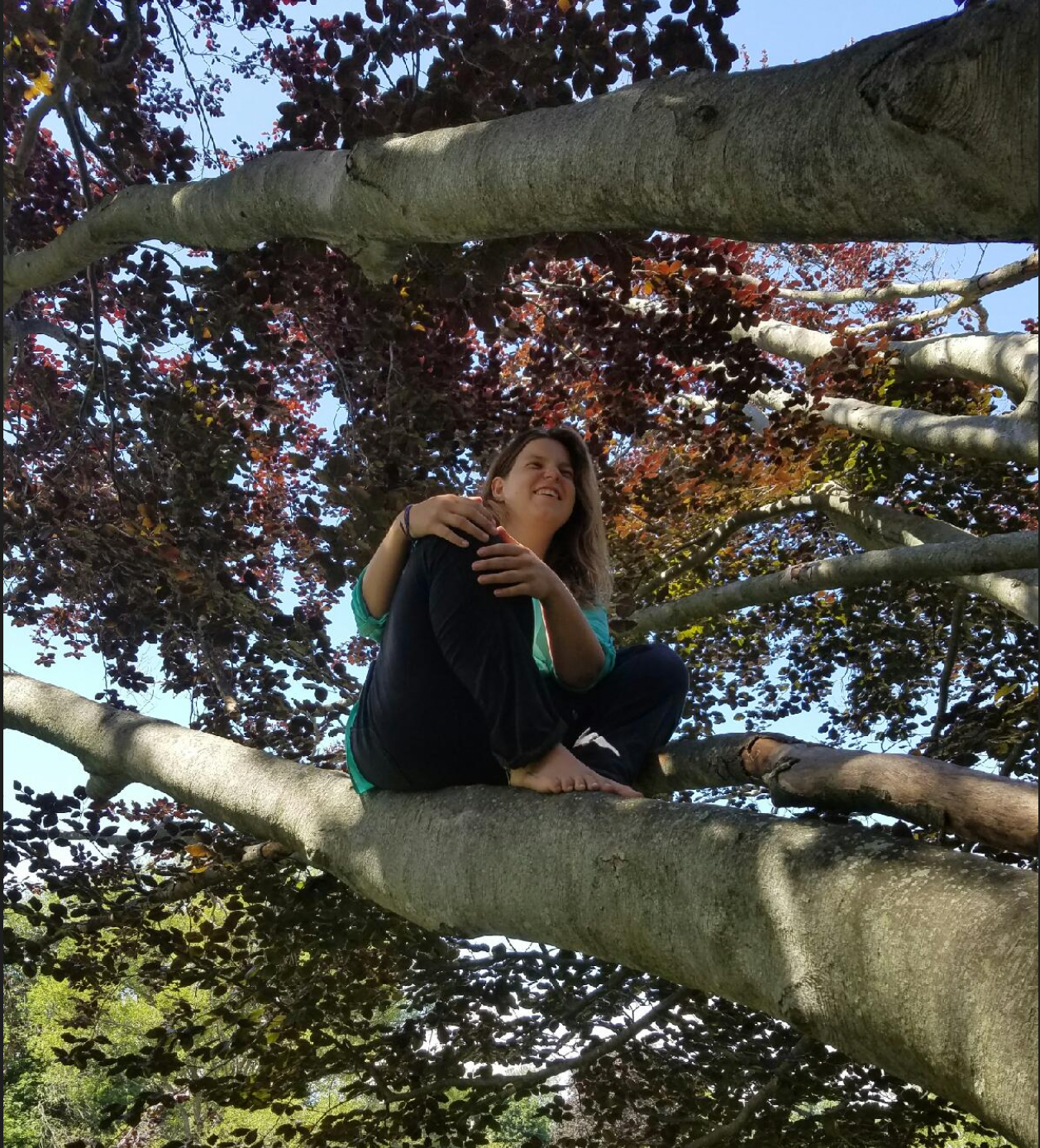
Marie sitting on elder beech tree on the bottom of East Rock, New Haven, CT, which died in 2024.
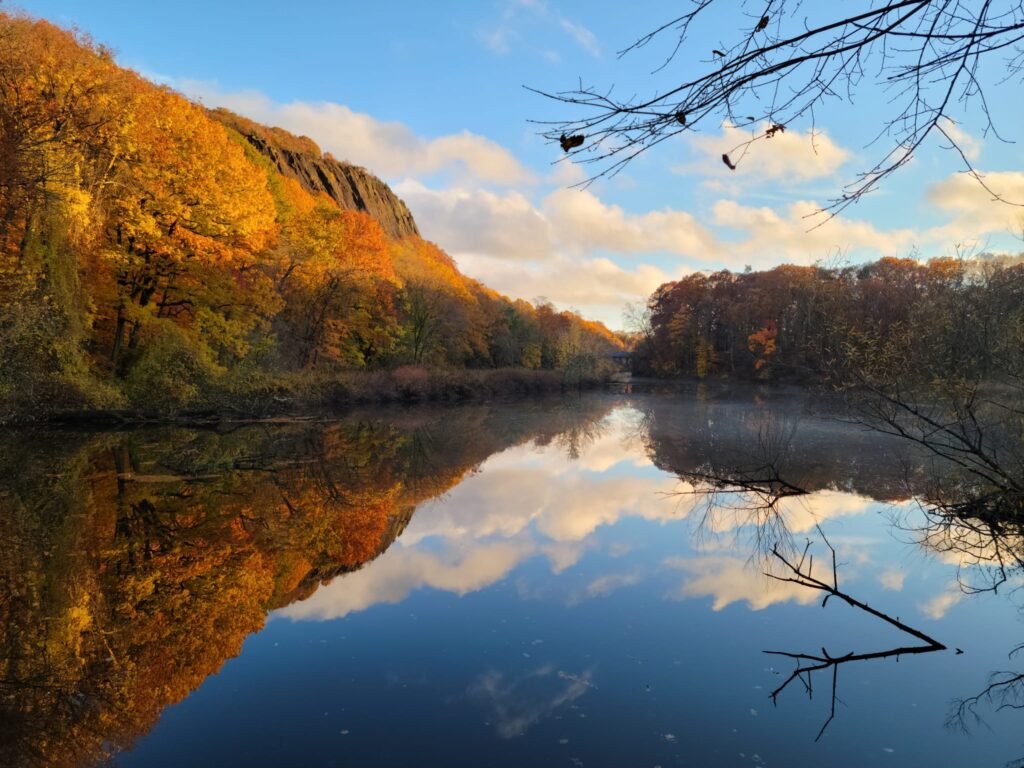
Marie: Photograph of East Rock in New Haven, CT.
.
When I, Marie, moved to Boston, I started walking at lunch time to the Boston Commons, making friends with a dawn redwood. There, immersed in their presence the frenzy of performance training and the business of the city would disappear. And as I merged with the tree, I became a safe space for squirrels, who, to my delight, regularly visited me and sat on my lap. Similarly to Lena, these were important moments for me to find belonging in a new place where navigating new and entangled human cultures was marred with the anxieties that necessarily come with migration.
These friendships brought me a new sense of belonging, that I carry with me as I encounter trees across the world. And in the process, I learned to slow down and quiet enough to become open to listening deep and attune to the trees, the pond, the river, the squirrel, the ants, and the interconnected paths that are constantly moving and flowing.
For both of us, small moments of care, attention, and gratitude that may have seemed insignificant become anchored in memory, offering strength and grounding wherever we find ourselves. While a single tree cannot repair the losses created by displacement and disconnection, caring for one can become a way of learning how to belong again.

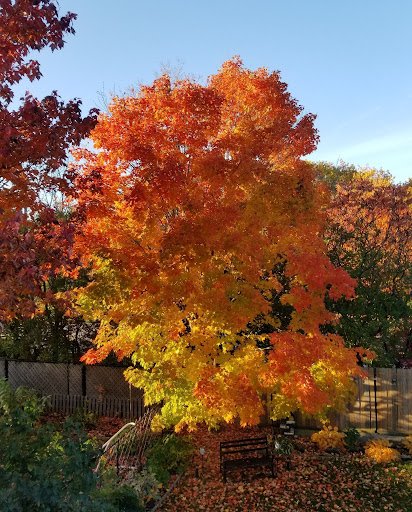
Maple tree in Lena’s backyard in a fall. Year after year such an incredible experience to see the maple tree leaves change in a fall to bright yellow, red, and orange that shine beautifully during morning hours.
Wanna share about listening practices? Join the current!
Did you catch a mistake? Report it for a krill!
Listening with Whales is a living, growing digital commons. Grow it out.