Grieving with Whales
Cover image: Tahlequah holding her calf Tali afloat. NOAA Fisheries, Public domain, via Wikimedia Commons.

Grief, more than any other mode of listening and attuning, emerged as a through-line across all categories of listening, revealing how porous these categories are, and thus is found across all the pages. Find it in the genetic code that still hold the collective trauma of commercial whaling; in the touch of dying whales and the creation of a new keening ritual; in the holding words of poets; in the developing of a historical ear; in the whalish music emerging in commercial whaling countries since the 1970s; in the collective grief that motivates us to change; and in longstanding ancestral connections between humans and whales.
“It’s not easy to know how to make a life, much less avert planetary destruction. Luckily there is still company, human and not human. We can still explore the overgrown verges of our blasted landscapes—the edges of capitalist discipline, scalability, and abandoned resource plantations. We can still catch the scent of the latent commons—and the elusive autumn aroma.”
Dr. Anna Tsing
The Mushroom at the End of the World
How to cite this section: Comuzzo, Marie and Marianna Ritchey, “Grieving with Orca Tahlequah,” Listening With Whales, 21 September 2026, https://listeningwithwhales.org/grieving-with-whales/#tahlequah
Grieving with Orca Tahlequah
On July 24, 2018, Tahlequah, a resident orca of the Puget Sound, gave birth to her baby, Tali, who died shortly after. For seventeen days, she and her pod held Tali’s body afloat. We suggest understanding Tahlequah’s unusually long grief ritual as being a response to more than her own personal loss. The Southern Resident community in the Pacific Northwest once numbered around 200 orcas. But these numbers began dwindling in the 1960s (which saw a period of intense orca live-capture where many young individuals were kidnapped, arrested, and given life sentences in SeaWorld parks) and have been steadily declining ever since.
In December 2024, many celebrated, and then grieved, alongside Tahlequah when another of her offspring (dubbed “J61”) was born and passed away on New Year’s Eve. It was a tragic way to end the year, and it serves as a reminder to hold these deaths close, to let them move us, and to allow our grief to motivate us to change (see LWW poetically).
Tahlequah’s grief had major consequences in many human communities and prompted a world-wide emotional outreach to her loss. Not only did this spur new grassroots arts and community-building projects and legislative changes but also, on an even more material level, the reigniting of demands to dismantle the systems of hydroelectric dams that are decimating salmon and disrupting Indigenous human lifeways.
Tahlequah’s grief also spurred the formation of new communities. On the same land that holds the home of Tahlequah and her pod, collective grief brought 200 people attune together and record their mourning through song in WAILS: Songs for Grief (2024). This project was begun by Alexandra “ahlay” Blakely who explains that such sonic mourning practices, historically led by women and non-binary people, have often been seen as dissident and heretic because they lead to unrest and resistance against the State. These rituals, as well as their repression, were still common in Scotland and Ireland until the mid-twentieth century and records of similar mourning practices (and suspicion about them) date back to Ancient Greece.
The goal of communal work such as this is to help participants actively feel the suffering that many are trained to repress, and that can turn grieving into a practice that sparks a desire to resist the utilitarianism of modern capitalist life. Grieving with Tahlequah thus prompted many diverse practices we understand as attempts to “erosically attune” with whales as well as with humans’ own feelings of rage and sorrow
The full article, “Erosic Attuning and Grieving with Whales: Towards Ecosystemic Comradeship,” co-written by Marie Comuzzo and Marianna Ritchey is forthcoming in November in TRACE: Journal of Human and Animal Studies. Email us if you’d like to be notified when it does.
“and we didn’t even get the chance to heal the wounds of stolen people
genocide, immigration and deracination
we are becoming hardened
because we don’t open the door when we hear the knock of grief
standing humbly on their knees waiting to be seen and rocked
instead they festor growing into shadows that hunt us for lifetimes
and make us ill causing such deep aching that we keep hurting each other”
Ahley Blakely
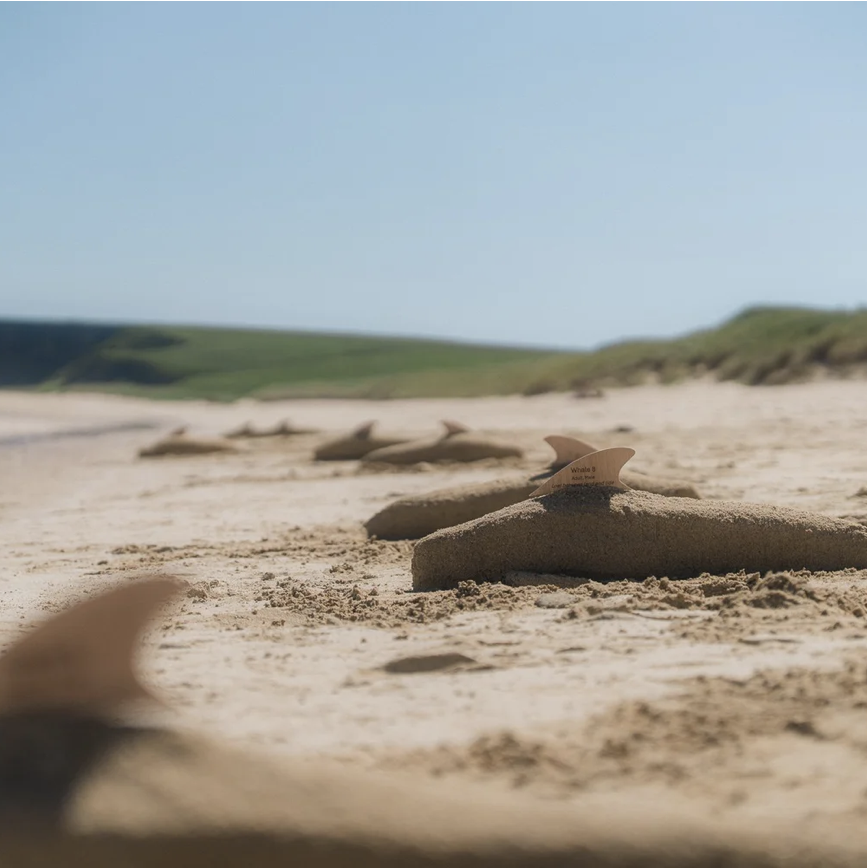
“Sand Whales,” as part of Keening: Song for the Stranding. Photograph by Phil Hall. Reproduced with the authorization of Alex South.
How to cite this section: Comuzzo, Marie, “Grieving with Pilot Whales,” Listening With Whales, 21 September 2026, https://listeningwithwhales.org/grieving-with-whales/#keening, based on an interview with Alex South.
Grieving with pilot whales
Born as a collective response to the Lewis stranding, “Keening — Song of the Stranding” is an interdisciplinary collaboration between artist Sam Gare, musicians Alex South, Katherine Wren, and Nerea Bello, as well as Aya Kobayashi, Aoife Glass, and the public, to grieve together the mass stranding of 55 long-pinned pilot whales in Outer Hebrides on July 16, 2023. The day-long ritual involved making sand sculptures of pilot whales when the tide was low.
Traigh Mhòr beach on the Isle of Lewis (Outer Hebrides, Scotland), a liminal space between land and ocean, and life and death, held the ritual mourning through a collective, multidisciplinary response.
Sun high, the tide retreated and uncovered the beach, revealing the one and a half kilometer length where the pod lay together, reaching out to each other in ever subdued calls, as humans from the nearby community gathered to wash their bodies with water to keep them hydrated, with covered with cool blankets.
Sand gathered from the distance, the tide retreats, a procession accompanied by the musicians carries a large mold for one of the two largest pilot whales, identified as a highly interconnected matriarch.
Then, a procession was held, and as the tide was coming to reclaim and wash away the whales, people gathered alongside them as they did with their real bodies a year before, and collectively grieved as Alex South, Katherine Wren, and Nerea Bello accompanied the ritual with traditional keening, as well as pilot whales inspired music.
After the initial melodic ribbon is formed, layering textures where viola and clarinet melt into each other until the voice emerges, alone again. The lament then moves from periods of isolation to calls and responses between the voice and clarinet, the clarinet and the viola, and rarely, all three. The timelessness and spaciousness of the keening creates an otherworldly atmosphere that fills the space without a clear direction or ending, rather it ripples like a wave in a still lake, becoming larger and fuller as it expands and fills the ever growing emotional space. As the rippling wave subsides, the atmosphere remains thick with the grief that it holds, inviting to stay in the sadness and the grief that loss and death demands. As the ritual comes to an end, people weave along the disappearing whales, feet in the water, tide washing away their loss.
As the tide returns, the waves wash away the dead, calling their bodies back to the ocean. As the ocean reclaims them, the keening lament fills the air, intertwining a lone singing voice with the clarinet and the whale, passing the melody to each other, one at the time, creating a touching continuum that though doesn’t overlap.
These emerging rituals connect to a deeper tradition of keening and kinning, whereby our interconnectness with more-than-humans is at the root of our existence. Through these multispecies emotional and sonic encounters in different forms of sonic kinning, entangled empathy, and erosic attuning, the death of our extended community becomes something we keep close and let them move us (see also erosically attuning).
If you would like to share, this current can hold a poem, an artwork, a song, a blessing, or simply a word.
Did you catch a mistake? Report it for a krill!
Listening with Whales is a living, growing digital commons. Sing it out: share this page!