Listening Erosically with Whales
Written by Marie Comuzzo and Marianna Ritchey
To envision a world beyond what is, is to intently desire for something different. Erosic Listening starts here, in the space between what is and what could be, as an infinite space of possibilities that lives, at first, within. It is a practice and an ethos that embraces anger, grief, and discomfort as a powerful practice to find direction, meaning, and the will to let erode what needs to fall apart.
Grounded in Black feminist scholar Audre Lorde’s centering of anger and eros as transformational practices for collective change, erosic listening is an introspective practice of listening with and attunement both within ourselves and with others.
“Erosic” contains both the ancient meaning of Érōs, a word Socrates used to describe generating something new and beautiful; and “erosion,” a slow and persistent transformation of even the most seemingly immutable landscapes. Érōs as this ancient force is something that can be felt, but that the mind or intellect (Lógos) cannot quite grasp, and thus it is an embodied ability to desire something different beyond what already is (including law, as specifically discussed in The Symposium).
Erosic Attuning insists that whales, forests, tempests, oceans, rivers, and humans, carry erotic force within them that sometimes also expresses itself through sound and that this force must be reckoned with through our bodies. Embodying Érōs and thus desire is here not a selfish pursuit, but rather, a moral compass. To erosically attune is to practice allowing bodily feelings to guide a certain pursuit of knowledge, of ourselves and others. It necessitates a confrontation with feelings of anger, rage, grief, and other internal states we are taught (in Western societies) to repress in favor of “positive thinking,” “spiritual bypassing,” or indifference.
Erosic listening and attuning enables us to connect with networks of kin and care that stretch beyond our species. This in turn helps us work toward collective change and grow our political imaginations. Our ability to stay and step into the discomfort of not knowing how to move forward, but at the same time, holding the possibility of a better future, enables us to imagine creative solutions beyond what is.
We developed erosic attunement as a theory and practice of whole-embodied listening that requires the ability to not only stay with the discomfort – including heavy emotions such as anger, despair, grief, and suffering – but to also reach beyond ourselves and humanity, into a space of attuned animality. Doing so, we practice becoming better animals, a process only possible if we stop perceiving ourselves as exceptional, superior, and entitled, and instead start relating to the other as an important co-creator of an ecosystem of being.
Kinning, or perceiving the more-than-human world as kin is something First Nations and indigenous communities have been relentlessly teaching about, and thus, this practice is also rooted in the shared wisdom of many different cultures who albeit differently ultimately advocate for an interrelationship with the world that is reciprocal, giving, and regenerative. Kin as a verb was specifically theorized by Robin Wall Kimmerer.
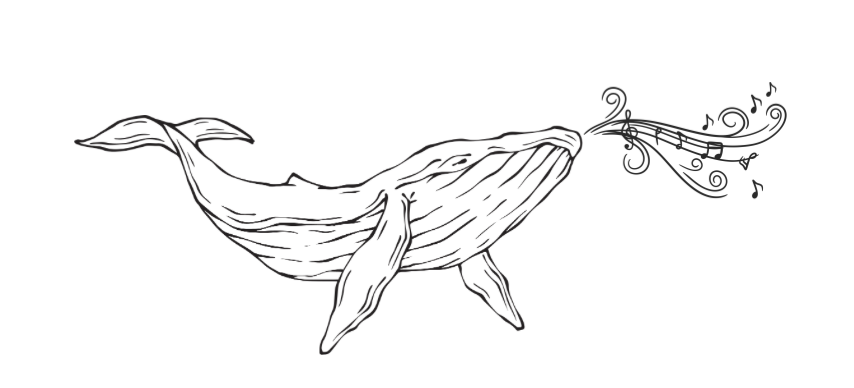
Deep in the ocean, where light doesn’t reach, whales keep in touch through sound that travels through vast distances. Whether it is language, music, poetry, laughter, echolocation, prayer, or asemantic sounds—we simply don’t know—their voices reverberate in the ocean as much as ours do in our human culture. We use, manipulate, rethink, transform, mix these sounds and use them in countless ways: from evocating awe for the more-than-human world, to bringing us to rest, or to communicate the urgency to change our ways, whale songs have become an anthem of our ability to transform when faced with the destructive power of economic greed.